
What is a friction-type fastener?
2026/05/07
Friction-type fasteners are mechanical components used to connect rotating shafts to pulleys, gears, and other components in various industrial machines.
Friction-type fasteners, sometimes referred to as keyless bushings depending on the application, are widely used in industrial machinery, machine tools, semiconductor manufacturing equipment, food processing machinery, and other fields.
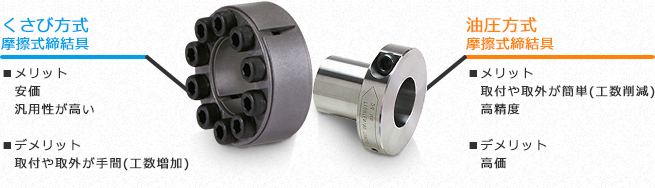
The two main types are the wedge method (mechanical method), which utilizes the principle of the wedge, and the hydraulic method (hydraulic system), which utilizes Pascal's principle.
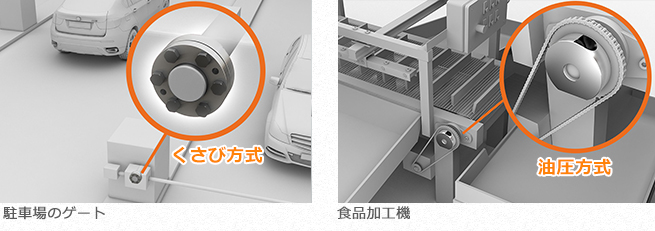
By thoroughly understanding the characteristics of each type and selecting the appropriate friction-type fastener based on its intended use and installation location, you can achieve various benefits, such as reduced labor hours and improved maintainability.
Table of Contents
The Role of Friction Fasteners
Why are friction-type fasteners necessary?
Traditionally, the most common methods of shaft fastening have been those using keys or set screws.
However, there are several challenges associated with fastening using keys, set screws, and similar fasteners.
- It is not suitable for machinery that requires high precision due to backlash or poor rotational balance.
- This incurs additional costs because the shaft must be machined (for keyways or to create a flat surface).
- Scratches on the shaft or fretting wear (shaft shrinkage or seizing) can occur, reducing the shaft's strength.
- It is difficult to align the phases, making it hard to position the cams and gears.
- Vibration or other factors may cause the key to slip out axially, making a retaining device necessary.
- Vibration and other factors can cause set screws to loosen, making a lock nut necessary.

Friction-type fasteners are used to address these challenges, and when employed in such applications, they are also referred to as "keyless bushings."
Recently, the applications and types of friction-type fasteners have diversified, and their use is no longer limited to keyless bushings alone.
Types and Characteristics of Friction Fasteners
Friction-type fasteners include the highly versatile wedge type and the low-maintenance hydraulic type. By selecting the appropriate friction-type fastener for your specific equipment, you can achieve a wide range of performance capabilities.
: While inexpensive and highly versatile, installation and removal require considerable effort and time.
: Although slightly more expensive than the wedge type, it offers excellent maintainability and allows for quick, easy, and highly precise installation and removal.
| Types | Photo | Torque | Workability | Positioning Accuracy | Concentricity | Price | Tolerance | Temperature | Details |
|---|---|---|---|---|---|---|---|---|---|
| Wedge method | 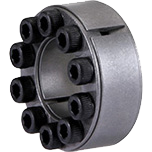 | ◎ | △ | △ | △ | ○ | ◎ | ○ | Details |
| Hydraulic method | 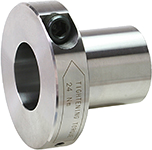 | ○ | ◎ | ◎ | ◎ | △ | ○ | △ | Details |
This video compares the installation times for friction-type fasteners.
To maximize the benefits of friction-type fasteners, it is essential to select the type best suited to the specific location and application. The detailed characteristics of each type are explained below.
1. Characteristics of the Wedge Method (Mechanical Method)
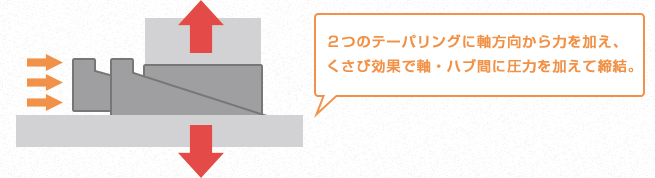
Friction-type fasteners using the wedge mechanism consist of a cylindrical component and several other parts, such as screws. They
are generally referred to as "wedge mechanisms" or "mechanical mechanisms."
This method applies force axially to two tapered surfaces, utilizing the wedge principle to generate high frictional force between the shaft and hub to secure the connection.
It is compact and capable of transmitting high torque, while allowing for greater machining tolerances in mating parts.
Additionally, it can be used on shafts with keyways under certain conditions.
Principle of Operation
Tightening the bolt moves the outer sleeve. Friction is generated between the outer sleeve and the inner sleeve, securing the shaft to the hub. (Principle of the wedge)
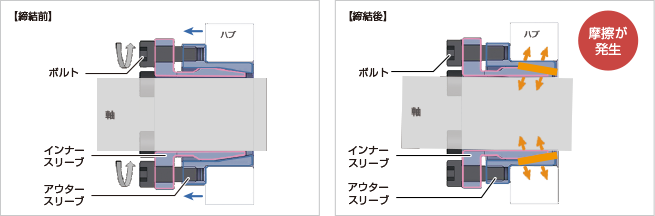
However, using multiple screws can make installation and removal time-consuming and may lead to screws being left loose.Furthermore, when removing the hub, it is important to note that space is required both for tightening the screws and for inserting the removal screws (extraction taps). Additionally
, several factors must be considered, such as the fact that the high contact pressure results in a larger hub outer diameter, the potential for self-locking (where the wedge engages and prevents removal), and the difficulty in positioning the hub during installation due to axial movement.
Summary: The Benefits of the Wedge Method
- Compact yet capable of transmitting high torque
- Larger machining tolerances can be allowed for mating parts
- Can also be used on shafts with keyways
Summary: Points to Note About the Wedge Method
- Because multiple screws are used, installation and removal may take time, and there is a risk of forgetting to tighten a screw
- It is difficult to position because it moves in the axial direction
- If you need to remove it, you will need a tap or similar tool
- Care must be taken in component design due to the high contact pressure on the mating part
2. Characteristics of the Hydraulic System
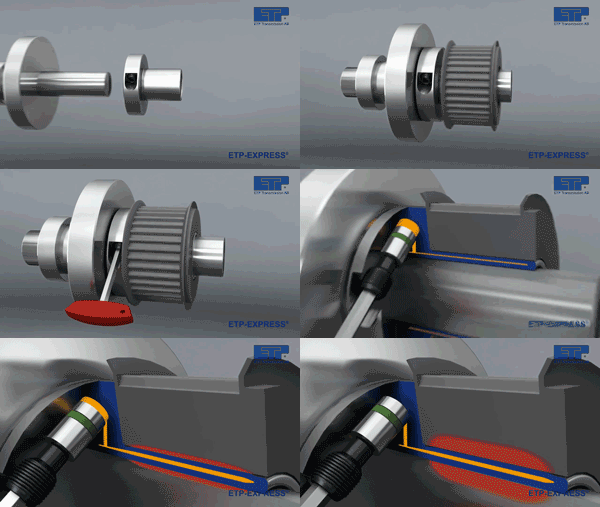
Hydraulic friction-type fasteners utilize Pascal’s principle to secure components.
(About Pascal’s principle) They are generally referred to as “hydraulic systems” or “hydraulic
fasteners.” By pressurizing and compressing the pressurized fluid enclosed within a sleeve using a single screw, friction is generated between the shaft and the hub to secure the connection (→ Click here for a video explaining the operating principle).
Principle of Operation
Tightening the bolt (pressure screw) pressurizes the fluid (oil) inside the sleeve. The sleeve expands, securing the shaft and hub together. (Pascal's principle)
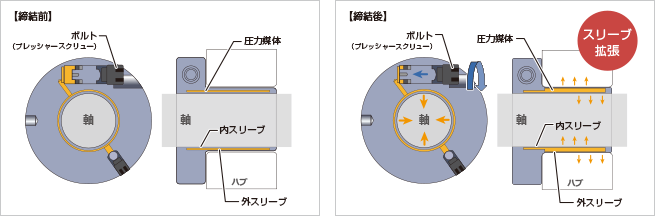
It can be installed and removed in a limited workspace, and anyone can install it with high precision by simply tightening a single screw. Furthermore
, it offers advantages such as the ability to reduce the hub’s outer diameter due to low surface pressure on the hub side, the absence of self-locking, and ease of positioning during tightening.
However, since the torque varies depending on the operating temperature, care must be taken regarding the operating environment.
Also, if there is a keyway, it must be filled.
Although the price is higher compared to the wedge method, using this system in areas requiring frequent assembly and disassembly or high mounting precision can significantly reduce labor hours and lower total costs.
Summary: The Benefits of the Hydroponic Method
- Easy to install and remove
- Anyone can install it with high precision
- Easy to position
- The contact pressure on the hub side is low, allowing for a smaller hub outer diameter
- Self-locking does not occur
Summary: Points to Note About the Hydro Method
- If there is a keyway, it must be filled
- Caution is required because torque varies depending on the operating temperature
Optimal Applications and Benefits Based on the Characteristics of Friction-Type Fasteners
Ideal applications for the wedge method
The wedge method requires the use of multiple screws during installation, which makes mounting and dismounting time-consuming.
Additionally, because the hub tends to shift axially, positioning can be difficult. For these
reasons, it is best suited for applications where the assembly is rarely removed and high-precision mounting is not required.
Ideal applications for the hydro method
Thanks to its innovative structure and operating principle, the Hydro system allows fastening with a single screw, making positioning easy and enabling high-precision installation. As a result, adopting this system in areas requiring frequent assembly and disassembly—such as during changeovers, disassembly, and maintenance—or where high-precision installation is essential, can lead to significant reductions in labor hours.
The following section presents specific calculation examples to illustrate the extent of these efficiency gains.
Calculation Example
For example, consider a case where a wedge-type fastener is used on equipment that requires frequent maintenance. By reviewing
the system and replacing it with a hydraulic friction-type fastener, you can achieve significant labor savings.
Based on the following example, replacing just one wedge-type fastener with a hydraulic friction-type fastener can reduce labor costs by over 20,000 yen per year. Please apply your specific operating conditions to determine
whether the wedge method or the hydraulic method is more effective for your application.
(→ Click here to watch a video comparing installation and removal times for the wedge method and the hydraulic method)
| Wedge method | Hydraulic method | |
|---|---|---|
| Labor rate | 35 yen/minute | |
| Number of installations/removals per day | 1 time | |
| Installation time per session | 200 seconds | 20 seconds |
| Removal time per session | 200 seconds* | 10 seconds |
| Price | 5,500 yen (for PSL-G-30) | 13,310 yen (for ETP-E-030-NH) |
*Because the wedge-type design features a self-locking mechanism during removal, the removal time is the same as the installation time.
When comparing the wedge method and the hydraulic method under the above conditions…
Time saved per installation/removal = 370 seconds Daily labor
savings ≈ 215.8 yen
Annual labor savings (240 days) = 51,800 yen Price difference between
the wedge method and the hydraulic method
= 7,810 yen By adopting the hydraulic method
in one location… annual labor savings = 43,990 yen
Examples of Friction-Type Fasteners in Use
Miki Pulley's Lineup of Friction-Type Fasteners
Miki Pulley's lineup of friction-type fasteners is as follows. The features and
details of each model are presented in a table. Click
the "Details" button to view detailed information on each model, including specifications, dimensions, drawings, structure, and materials.
| Model | Method | Photo | Features | Case Studies | Specifications | |
|---|---|---|---|---|---|---|
| ETP-E Plus (ETP Bush) | Hydraulic Type | 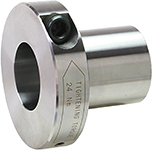 | Compatible with Motor Shaft Dimensions | Single-bolt clamping | >Application Examples | Details |
| ETP-T (ETP Bushing) | Hydraulic System | 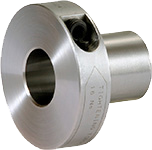 | High-Precision Installation | Single-point clamping | >Application Examples | Details |
| ETP-A (ETP Bushing) | Hydraulic System | 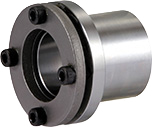 | High Radial Load Capacity | Fewer Bolts | >Please contact us | Details |
| ETP-H (ETP Bushing) | Hydraulic type Wedge type | 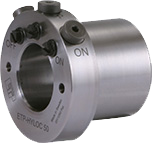 | High radial | High torque | >Application Examples | Details |
| PSL-G (Posilock) | Wedge Type | 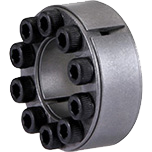 | High Torque | High Radial Load Capacity | >Please contact us | Details |
| PSL-K (Posilock) | Wedge-type | 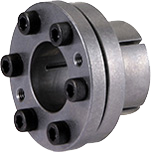 | Low inner-to-outer diameter ratio | Capable of withstanding high radial loads | >Please contact us | Details |
| PSL-D (Posilock) | Wedge type | 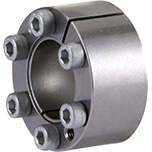 | For medium loads | High radial load capacity | >Please contact us | Details |
Case Studies of Hydraulic Friction Fasteners
We frequently receive inquiries from customers regarding examples of applications for hydraulic friction clamps. Below
, using Miki Pulley’s products as an example, we explain the specific applications of hydraulic friction clamps and the benefits they offer.
ETP-E Plus Model Case Studies
↓Conveying, Packaging, and Printing Machinery
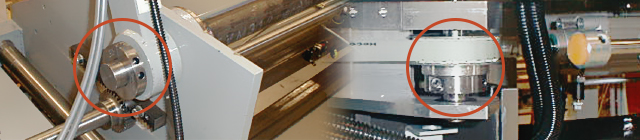
The ETP-E Plus is used in a wide range of applications in conveying, packaging, and printing machinery. It allows for final positioning and phase
adjustment of timing pulleys and sprockets with a single bolt. Furthermore
, since adjustment
is possible from the radial direction, it contributes to space-saving designs. Additionally, it can be used with hubs made of materials that cannot withstand high surface pressure, such as aluminum and cast iron, thanks to the uniform surface pressure provided by the ETP hydraulic clamping system.
↓Newspaper printing inserter
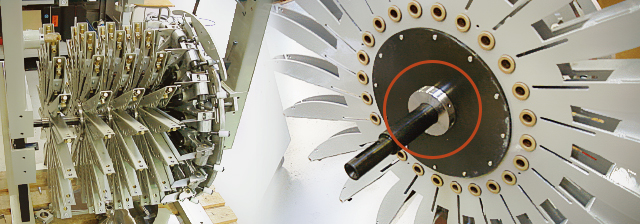
The insert feeding mechanism for newspaper printing required radial mounting to secure the radial feeders to the shaft. Additionally, high concentricity was required to minimize vibration.
The ETP-E Plus features a single-clamp design, enabling radial mounting. Furthermore
, its high concentricity makes it capable of addressing these challenges.
↓For conveyor applications requiring positioning and synchronization, such as in chain-driven systems
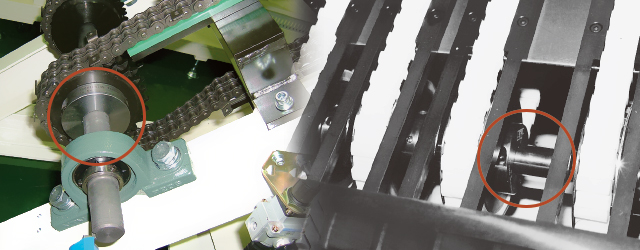
This tool is useful for adjusting the rotational phase of pulleys and sprockets.
The ETP-E Plus allows for easy loosening, adjustment, and tightening from the radial direction using just a single bolt, even in tight spaces. Adjustments can be made quickly, improving production efficiency.
ETP-T Model Case Studies
↓Securing rollers on an automotive aluminum radiator production line
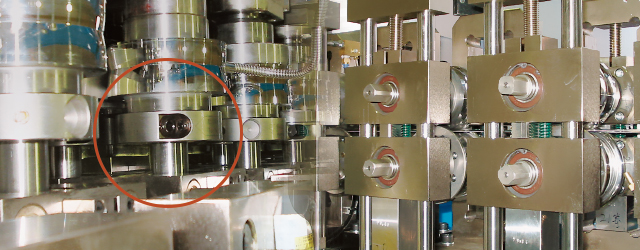
The ETP-T model features ultra-high precision with a concentricity of 0.006 mm. It allows for easy axial adjustment and positioning. For example
, it is used to secure rollers on automotive aluminum radiator production lines, where it ensures reliable concentricity and allows for easy adjustment of axial positioning. Once secured
, it can withstand high thrust loads, and during production line setup changes, the mounting can be adjusted with a single bolt.
↓Fastening special carbon fiber gears in printing machinery using the ETP-T model
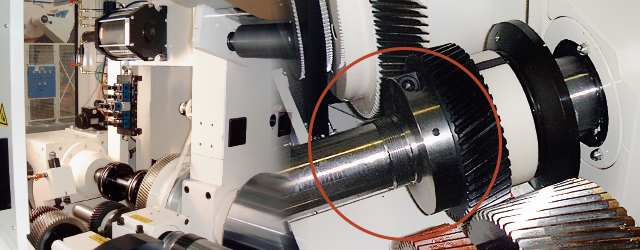
The ETP-T model maintains the permissible surface pressure of flexible special gears and prevents deformation by applying moderate, uniform surface pressure. In addition, its high-precision mounting reduces imbalance and noise.
ETP-H Model Case Studies
↓For securing the steel rolling rollers
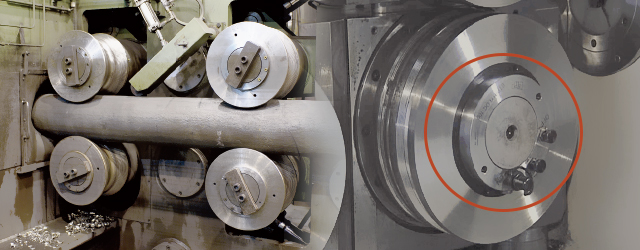
The ETP-H model allows for precise adjustment and positioning of the rollers
. It can withstand high radial loads. Roller replacement is quick and easy thanks to the hydraulic pump.
To maximize the benefits of improved work efficiency and increased production efficiency as we review and improve our production systems, it is essential to start by reevaluating even a single component and selecting the optimal parts for each application to ensure they are perfectly suited to our customers’ equipment.
Leveraging the knowledge and technical expertise unique to Miki Pulley—a company with a long history in the fields of power transmission and control equipment, as well as mechanical components, and one that has long incorporated the Toyota Production System to improve its production systems—we propose mechanical components and friction fasteners that will deliver maximum performance in your equipment.
Please feel free to consult with Miki Pulley when reviewing your production systems or selecting components.
Examples of Customized Friction Fasteners
At Miki Pulley, we offer a wide range of custom and made-to-order products, and we can accommodate customization requests for nearly all of our products. We have established a flexible system to ensure we can meet each customer’s specific needs with the utmost care.
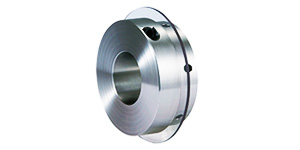
Customization Case Study
: Application Example for Slitter Knife Holders This is a hydraulic slitter knife holder. It is designed to secure rotating knives—used for cutting materials such as tinplate, steel plate, aluminum, and paper—at any desired position, allowing for precise axial positioning with a single bolt. The repeatability of runout caused by attachment and detachment can be maintained with micrometer-level precision.
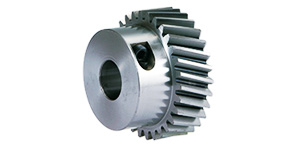
Customization Examples: Applications for Integrated Gear Designs By integrating
the gear into a single structure, extremely high concentricity can be achieved, enabling easy positioning in both the axial and meshing directions.
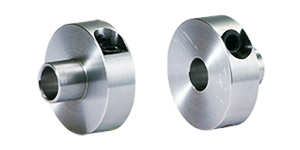
Customization Examples: Sleeve Lengths Tailored to Your Needs By shortening the sleeve
length from the standard type according to your requirements, we can accommodate hubs with thinner mounting surfaces.
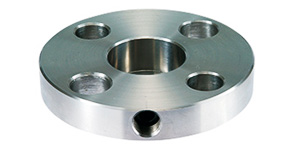
Customization Examples
: Applications for Part-Holding Tools When installed on a workbench or similar surface as a holder for assembly or machining, these tools enable stable operation. Additionally, they allow for extremely high repeatability in part positioning.
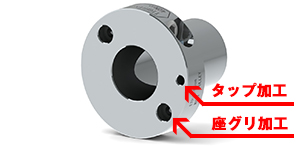
Customization Examples: When installing the unit on a machine for
re-machining seat holes or tapped holes
, it is possible to re-machine the seat holes for ETP positioning. *Please contact us regarding the re-machining positions.
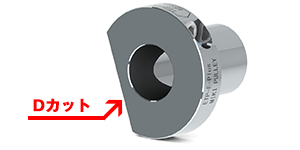
Customization Examples: Application
to D-Cut Shapes When installing the device, additional machining can be performed on interfering parts to prevent interference. For example, D-cuts. *Please
contact us regarding the D-cut positions.
When it comes to friction-type fasteners, leave it to Miki Pulley!
"I’d like to hear an explanation of the benefits of incorporating friction-type fasteners into our equipment." "
We’d like to review the friction-type fasteners we’re currently using..."
"We don’t know anything about design, so we’d like you to help us select the right ones."
If you have questions or requests like those listed above, please feel free to contact us using the inquiry form below. Our technical
staff will propose and explain the friction-type fasteners best suited for your equipment.