What Are Electromagnetic Clutches and Brakes? Their Types and Structures
2026/06/15
I've uploaded it!
What Are Electromagnetic Clutches and Electromagnetic Brakes?
Electromagnetic clutches and brakes are devices that control power transmission and rotational motion by utilizing the electromagnetic force generated when an electric current is passed through a coil. Clutches engage and disengage power transmission, while brakes decelerate and hold rotational motion; they can be classified into energized and non-energized types based on their operating mechanisms.
I will explain this electromagnetic clutch-brake in detail below. Since mechanical components
such as "clutches" and "brakes" are commonly used in bicycles and automobiles, you likely see them everywhere in your daily life.
However, while we often use the terms “clutch” and “brake” interchangeably, there are actually various types. Broadly speaking
, these include mechanical clutch brakes, hydraulic clutch
brakes, pneumatic clutch brakes, and electromagnetic clutch brakes. As their names suggest, these systems operate the clutch or brake using mechanical, hydraulic, pneumatic, or electromagnetic forces.
Among these, the electromagnetic clutch-brake—which operates using electromagnetic force—is commonly used in industrial applications.
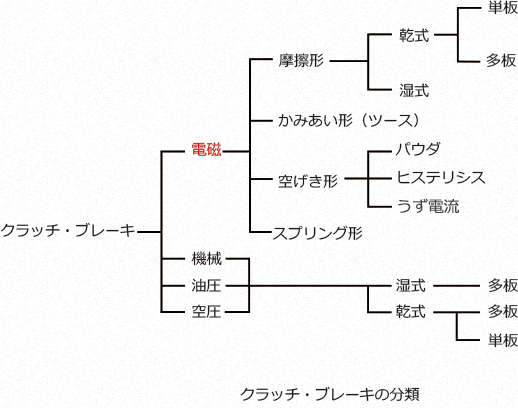
Since industrial clutches and brakes like these are often built into machinery and equipment, we rarely get the chance to see them in action. However, they play a crucial role in controlling the power of various machines.
Below, we will provide a detailed explanation of these "electromagnetic clutches and brakes."
Table of Contents
What is an electromagnetic clutch? What is an electromagnetic brake?
Electromagnetic clutches and electromagnetic brakes are mechanical components that use electromagnetic force to control power. Although they are often grouped
together under the term "clutch and brake" because their operating principles are similar, their functions are entirely different. Their respective functions are as follows:
The role of an electromagnetic brake: to stop the power
An electromagnetic brake is a mechanical component used to stop the flow of power.
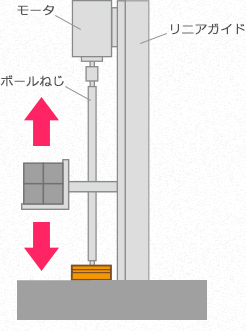
It uses electromagnetic force to stop, hold, or decelerate various types of motion. In practice
, it is commonly used in lifting mechanisms for conveying materials.
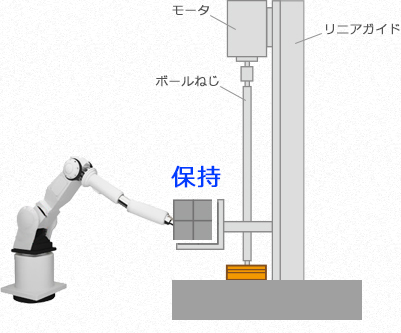
As shown in the figure below, brakes are used to raise the conveyor section to a certain position or to stop it at a predetermined position.
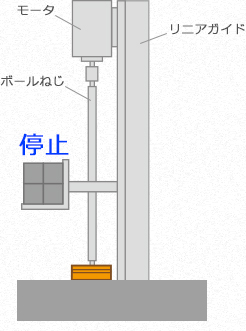
In addition to the roles mentioned above, they also serve to "maintain a stopped state.
" "Maintaining" refers to the function of preventing a machine or device from moving from the position where it was stopped. For example
, in the figure below, a brake is used to keep the lifting platform held at a specified position while a robot is placing a load onto it.
The role of an electromagnetic clutch: to transmit and interrupt power
An electromagnetic clutch is a mechanical component that uses electromagnetic actuation to transmit or disconnect power on the driven side. Simply
put, it allows you to disconnect or reconnect power without interrupting it.
Since the operation and function of an electromagnetic clutch can be harder to understand compared to an electromagnetic brake, please watch the following video first.
As for how clutches are used, for example, as shown in the figure below, by installing one between an electric motor and a conveyor (load), you can transmit or disconnect power from the motor to the conveyor without stopping the power (without turning off the motor, etc.).
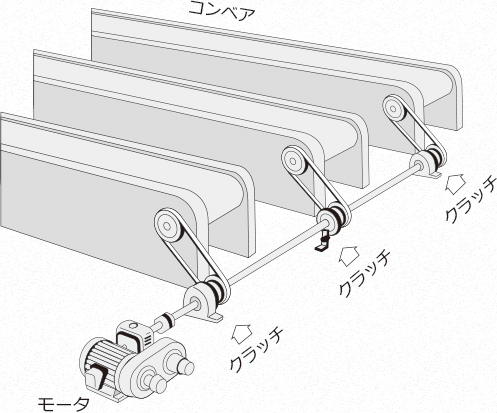
The most important point to understand about clutches is that they allow you to "control power without stopping it." In this diagram
, a single motor drives three conveyors. Suppose, for example, that you need to stop one of them due to an irregularity or other issue. In such
a case, if you use a clutch, you can stop only the necessary conveyor without stopping the motor (or the other two conveyors).
Summary 1: The Role of Brakes
・The function of stopping, maintaining, or decelerating the power
Summary 2: The Role of the Clutch
・The role of transmitting or interrupting power
Now, let’s take a look at the different types of clutches and brakes.
Types of Electromagnetic Clutches and Brakes
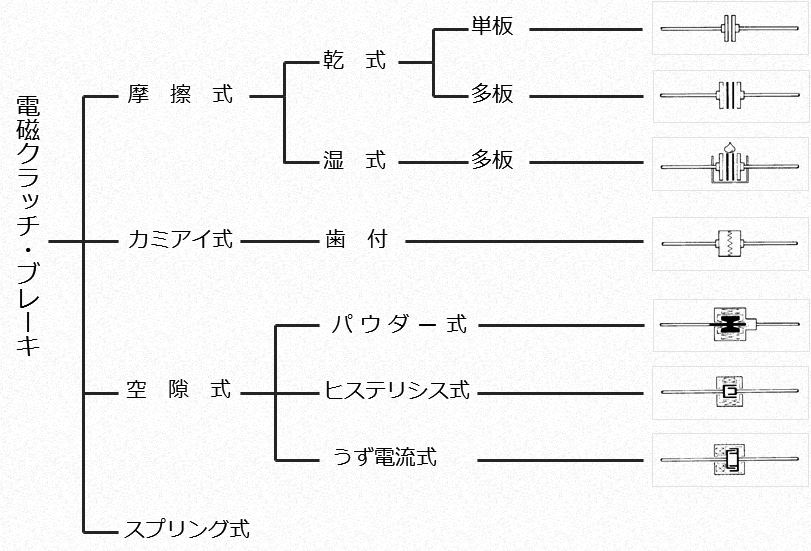
Electromagnetic clutch and brake systems include "friction-type," "cam-type," "air-gap-type," and "spring-type" designs. These are classified based on the method used to generate torque
. Since each type
has its own characteristics, the appropriate one must be selected based on the application.
Among these, the "friction type" is the most widely used in industrial applications due to its simple structure, low cost, and excellent controllability. It generates torque by
pressing friction materials against each other.
Miki Pulley primarily handles friction-type clutches and brakes, but we also offer intermeshing-type "tooth clutches" and spring-type "non-excitation-type brakes." Focusing on the
clutches and brakes available from Miki Pulley, we will explain the characteristics of each type.
Types of Electromagnetic Clutches and Brakes from Miki Pulley
Types of Electromagnetic Brakes
Miki Pulley's electromagnetic brakes come
in two types: energized-type and de-energized-type. The terms "energized" and "de-energized" are frequently used when discussing electromagnetic brakes. "Energized" means "operating when energized,
" while "de-energized" means the opposite: "operating when not energized."
In other words, an energized-type brake applies when power is applied, while a de-energized-type brake applies when power is cut off.
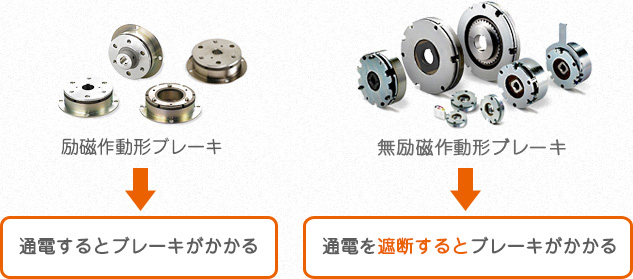
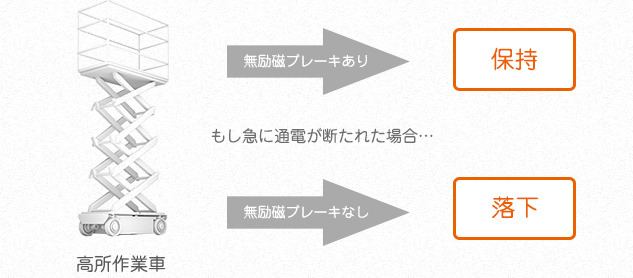
De-energized brakes are primarily used for emergency braking and holding in machinery or equipment. For example, in aerial
work platforms, if
power is suddenly cut off due to a malfunction, the bucket (the part that carries the load) could drop without this brake. By installing a de-energized brake, the system functions as a brake when power is cut off, allowing the bucket to remain held in place.
Types of Electromagnetic Clutches
Miki Pulley's electromagnetic clutches include the friction-type "excitation-operated clutch" and the meshing-type "tooth clutch." Each uses a different method to generate torque.
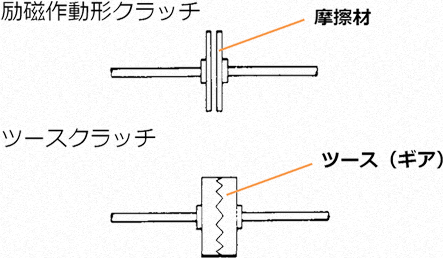
An electromagnetically operated clutch generates transmission torque by pressing the friction materials together. A
tooth clutch generates transmission torque through the power generated by the meshing of gears called "teeth." For this reason
, a tooth clutch can generate greater torque than an electromagnetically operated clutch.
Structure and Operating Principles of Electromagnetic Clutches and Brakes
Below, we will explain the structure and operating principles of "energized-type electromagnetic brakes," "energized-type electromagnetic clutches," and "de-energized-type electromagnetic brakes."
As described in the section on Miki Pulley’s types of electromagnetic clutches and brakes,
“excited” means “operating when energized.”
“Non-excited” is the opposite, meaning “operating when not energized.”
Furthermore, while energized-type clutches and brakes generate torque through friction,
non-energized-type brakes generate torque using spring force. The information
is presented in an easy-to-understand order, so reading from the top down will make it easier to follow.
Table of Contents
Structure and Operating Principle of Electromagnetically Actuated Brakes
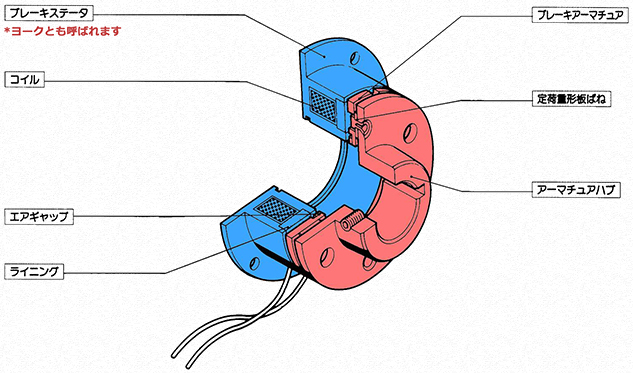
The structure and operating principle of an electromagnetically actuated brake are relatively easy
to visualize. An electromagnetically actuated brake consists of a moving part that rotates with the shaft and a stationary part that is fixed to a wall or similar surface. In this
diagram, the red part is the moving component, and the blue part is the stationary component. There is
a gap between the red and blue parts. This gap allows the red part to move.
Simply put, the red section, which moves with the shaft, is drawn toward and comes into close contact with the blue stationary section. This contact causes friction (and magnetic force) to stop the shaft’s rotation, thereby functioning as a brake.
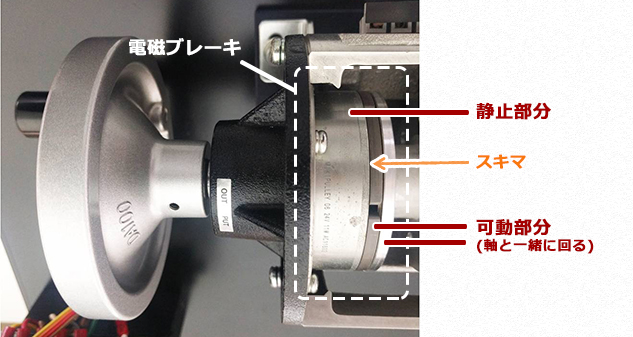
Here’s what it looks like in a real-life photo. When the brake is off
, you can spin the left handle freely, but when you engage the brake, the moving part—which was rotating along with the shaft—is pulled toward the stationary part and locks into place. This prevents the shaft
from rotating, so you can no longer turn the handle.
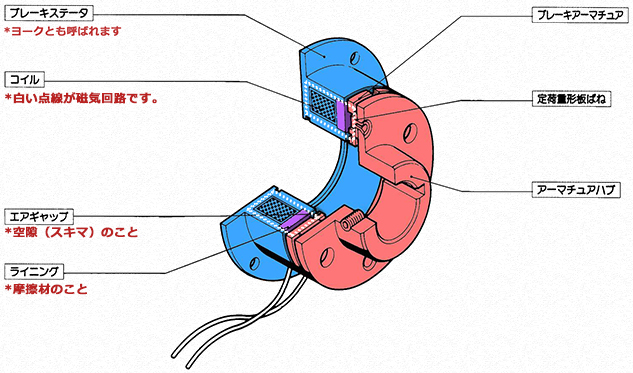
That’s a simple explanation, but I’ll go into a bit more detail about how it works below. It will be easier to understand if you read this while looking at the diagram above.
First, when the brake power is turned ON, current flows through the coil. This causes the brake stator surrounding the coil to act like an electromagnet. As a result
, the brake armature is drawn toward the brake stator by magnetic force. At this
point, there is a component called a “constant-load shaped leaf spring” between the movable armature hub and the brake armature.
This "constant-load shaped leaf spring" acts as a spring, allowing only the brake armature to move axially (toward the brake stator). In this
way, the brake armature is drawn tightly against the brake stator by magnetic force. At this point, friction is generated by the friction material known as the lining, enabling braking.
When the power is turned off, this magnetic circuit is broken, and the brake armature returns to its original position due to the spring force of the "leaf spring," releasing the brake.
Structure and Operating Principle of an Electromagnetically Actuated Clutch
Next is the power-operated clutch. Since it can be difficult to visualize how a clutch works
, I’ve created a video. If you watch it, you’ll see how the clutch moves to control power.
Below, I’ll provide a detailed explanation of how it works.
Let’s look at an example of how the clutch operates to transmit power to the pulley shown in the image below.
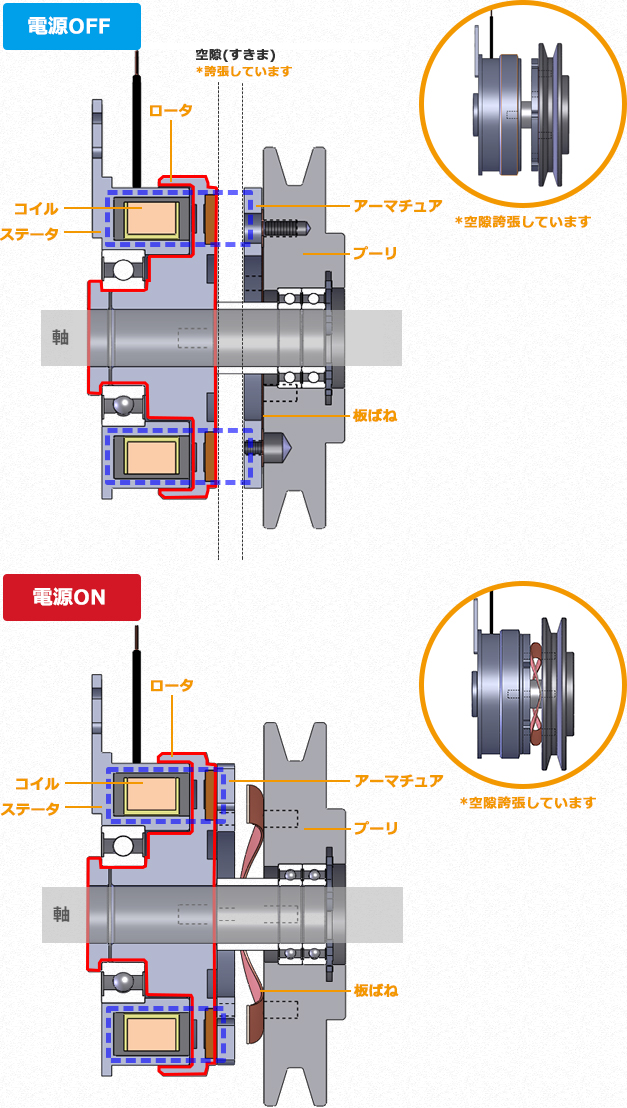
First, the part circled in red is called the rotor, which moves together with the shaft. When
the power is turned on, the coils built into this part—called the stator—become energized. As a result
, the entire stator acts like a magnet.
The magnetic force generated here passes through the rotor and attracts the part called the armature. The rotating part
(outlined in red) and the armature come into close contact, causing the pulley to move.
When the power is turned off, the magnetic circuit is broken, and the rotor loses its ability to attract the armature. Furthermore, a component called a "leaf spring," located between the pulley and the armature, causes the armature to return to its original position. This disengages the clutch, interrupting the transmission of power.
Structure and Operating Principle of Non-Excited Brakes
We have prepared a video that clearly explains the operating principle of non-excited brakes. We believe watching this video will help you better understand how non-excited brakes work.
Below, we will explain the operating principle of non-excitation brakes in greater detail.
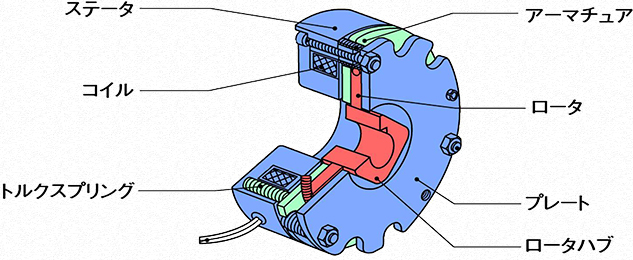
↑Unlike the electromagnetically operated brakes we’ve discussed so far, non-electromagnetically operated brakes generate torque using spring force. Their operating
principle is simpler than that of electromagnetically operated brakes.
Simply put, the red part that
rotates with the shaft is pushed upward by the green part, pressing it against the stationary blue part. This stops the shaft’s rotation, allowing the brake to function.
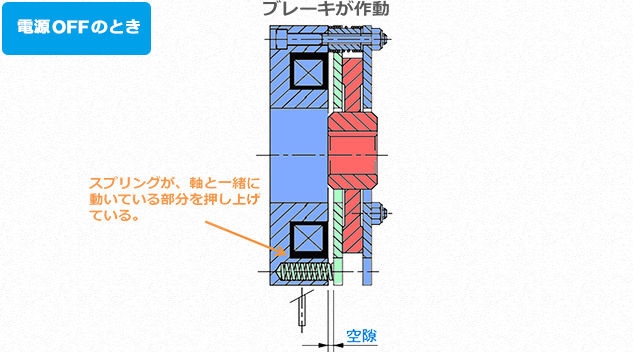
↑ Unlike electrically operated brakes, non-electrically operated brakes engage when the power is OFF. When the power is OFF
, the red part that rotates with the shaft is pushed upward by the spring in the green part. This causes
the red part to press tightly against the blue part, preventing the shaft from moving and putting the brake in the engaged state.
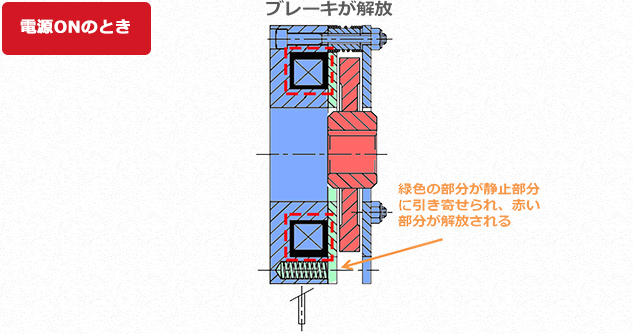
↑When the power is turned ON, the coil generates a magnetic circuit (red dotted line). As a
result, the spring that was previously pushing up the red section is overcome by the
magnetic force, and the green section is drawn toward and presses against the blue section. This releases the red section, allowing the shaft to rotate.
List of Content
Our skilled engineers will select the electromagnetic brakes and clutches best suited to your equipment!
Are you experiencing any issues with your equipment?
At Miki Pulley, we can help you select and customize electromagnetic clutches and brakes from our wide range of options to perfectly suit your equipment! Please feel free to
contact us using the form below.