
What Is a Sensor? | Easy-to-Understand Webinar
2026/06/15
What Are Sensors? A Veteran Engineer Explains the Types and Applications of Sensors—the "Senses" of a Device—in Easy-to-Understand Terms!
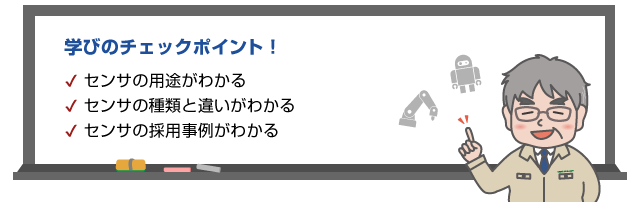
What is a sensor?
Definition of Sensors
Hama-chan: Professor Hashimoto! While learning about industrial robots, collaborative robots, and AGVs/AMRs, I noticed that “sensors” are used in them. This time, I’d like to learn about the types of sensors, how they work, and where they’re used!
Professor Hashimoto: That’s a great observation. Sensors play a crucial role in robots, AGVs, smartphones, drones, and more. Let’s start by learning the definition of a sensor. A sensor is defined as follows in the “Japanese Industrial Standards” (JIS-Z8103-2000):
・An element in a chain of instruments or measuring equipment that is directly affected by the measured quantity. Note: This term is sometimes used interchangeably with "detector." [Reference] JIS Standard https://kikakurui.com/z8/Z8103-2000-01.html
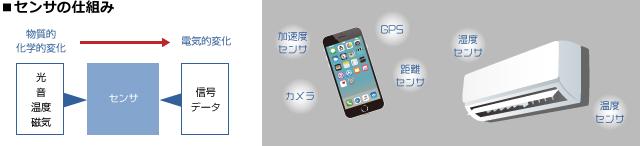
Mr. Hashimoto: A sensor is a device or apparatus that converts physical or chemical phenomena—such as sound, light, temperature, and pressure—into electrical signals or data. Sensors are used everywhere in our daily lives. For example, the air conditioner in your room is equipped with temperature and humidity sensors that measure temperature and humidity. Smartphones are equipped with GPS to determine your current location, accelerometers to detect tilt and movement, distance sensors to measure distance, and cameras, among other features.
What roles do sensors play?
Hama-chan: So there are various types of sensors. Could you tell me more about the role of each one?
Professor Hashimoto: Humans are equipped with various "sensory organs" represented by the "five senses": seeing, hearing, smelling, touching, and tasting. These are the "sensors" that humans possess. I’ve created a table that compares the "sensory organs" found in the human body with the "roles of sensors" in devices.

Joint
| Measures angle and rotation speed | A sensor that detects the angle of rotating joints in robots and other devices to determine their posture | |
|---|---|---|
Joint  | Potentiometer | Measures angular changes within a specific range on a given axis |
| Rotary encoder | Measures the angle and rotation count of objects that rotate multiple times on a specific axis | |
| Tilt sensor | Measures the tilt of the location where the sensor is placed | |
Balance  | Accelerometer | Measures how much the speed has changed per second |
| Gyroscope (Angular Velocity Sensor) | Measures how much the angular velocity has changed per second | |
| Measures force and torque | Sensors that measure force and torque by detecting changes in the force applied to an object | |
Force and Tactile Sensors  | Strain Gauge | Measures force and torque by detecting the displacement and deformation of an elastic body using strain gauges |
| Capacitive sensors | Detects changes in an object using capacitance | |
| Piezoelectric elements | Detects force, pressure, and other parameters based on the voltage generated when force is applied to a dielectric material (such as piezoelectric material) | |
| 6-axis force sensor | Measures force and torque based on changes in strain and capacitance | |
| Measures the shape, color, position, and movement of objects | A sensor that uses a camera to obtain visual information, similar to human vision A sensor that measures the distance to an object so that robots and AGVs can detect and avoid obstacles | |
Vision  | Image Sensor (Camera) | Calculates the area, center of gravity, length, and position of an object from images captured by a camera, and outputs data and judgment results |
| Stereo Vision | Captures images using two cameras placed in parallel to accurately measure the distance to an object | |
| Ultrasonic Sensor | Measures the distance to an object using ultrasonic waves | |
| Infrared Distance Sensor | Measures the distance to an object using infrared light | |
| LiDAR | Measures the distance and direction of distant objects using light | |
What kinds of sensors are there?
Hama-chan: So the roles of the five human senses are actually fulfilled by various sensors in devices, aren’t they! I’d love to learn more about each sensor!
Professor Hashimoto: Alright, then. I’ll explain the six most important sensors from the ones I introduced in more detail.

Encoder
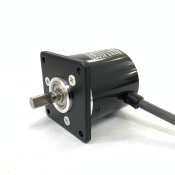
Sensors that encode rotational angles or linear displacement. Those that detect rotation are called rotary encoders, while those that detect linear displacement are called linear encoders.Rotary encoders contain a disk with evenly spaced slits. A light source is positioned on one side of the disk, while the other side detects the flickering of the light as it passes through. By measuring this, the encoder determines the rotation angle, rotational speed, and rotational frequency of the shaft. They are commonly used in servo motors and similar applications.
Accelerometer
A sensor that detects changes in velocity per second. While there are various types, the simplest designs consist of a spring with a weight attached to its end. By converting the changes in the spring’s extension or compression—caused by the laws of inertia during acceleration and deceleration—into electrical signals, the sensor measures acceleration. Recently, small, low-cost sensors based on MEMS technology have been widely used in a variety of applications.
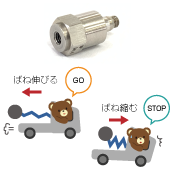
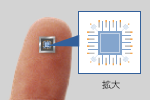
■What is MEMS?
Abbreviation for Micro-Electro-Mechanical Systems (MEMS). These are microstructures created using semiconductor technology, consisting of integrated devices that combine sensors, actuators, and electronic circuits. Because they are manufactured using semiconductor processes, a single IC is small—measuring approximately 1 cm square—and is both low-cost and highly integrated. They are used in smartphones, PCs, game consoles, and automotive sensors, among other applications.
Ultrasonic sensor
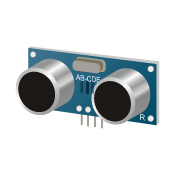
A sensor that detects the distance to an object by measuring the "time" between transmission and reception. TOF (Time of Flight), a commonly used method for distance measurement, refers to the time it takes for a signal to be emitted, reflect off an object, and return. The most common methods involve light and ultrasound. The sensor head emits an ultrasonic wave, which is then reflected by the object and received again by the sensor head.
LiDAR (Light Detection and Ranging)
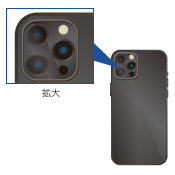
A type of optical sensor technology used to measure the distance to an object or determine its properties. It works by scanning an object with a laser beam and observing the scattered or reflected light. Time-of-Flight (ToF) technology is also utilized in the measurement process. LiDAR was used for distance measurement on the Hayabusa spacecraft, achieving a landing accuracy of 1 meter. It is also used in automobiles and smartphones.
strain gauge
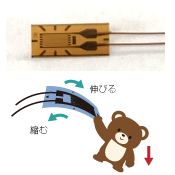
A sensor that detects strain as an electrical signal. When an external force is applied to cause it to stretch or compress, its resistance value increases or decreases accordingly. Therefore, if a strain gauge is attached to the object being measured, it will stretch or compress in proportion to the object’s movement, causing its resistance value to change. By detecting the displacement and deformation of the elastic material, it becomes possible to measure force and torque. *Strain refers to the amount of deformation—such as elongation or contraction—that a material undergoes in proportion to the external force applied to it.
Image sensor
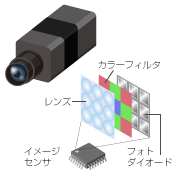
A sensor that processes data captured by a camera to output information such as the position, angle, shape, dimensions, and quantity of an object, and then compares this data with registered data to determine whether the object passes or fails inspection. It uses semiconductor elements that convert light into electrical signals and functions similarly to the human retina. Composed of several layers, it can capture color image signals by placing a color filter (RGB) between the microlens and the photodiode.
Where are sensors used?
Hama-chan: So sensors are useful in all sorts of areas of our daily lives, aren’t they!
Professor Hashimoto: There are still plenty of other examples of how they’re useful in daily life. Doorbells use image sensors and sound sensors, and outdoor lights that turn on automatically at night use light sensors to detect movement. Also, in smartphones, there’s GPS for location tracking and gyro sensors for preventing camera shake—there are so many examples I’d like to share!
Hama-chan: I’ll try to pay more attention to where sensors are being used in my daily life! Are there any examples of sensors being used in devices or machine parts?
Professor Hashimoto: Of course! I’ll introduce two examples from Miki Pulley.
Torque Sensor × Coupling
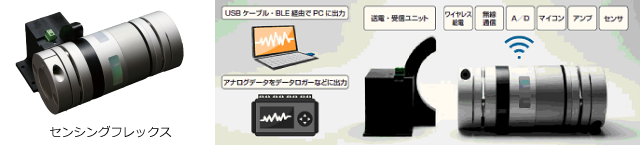
A sensor that detects the torque generated when a device rotates. A capacitive torque sensor converts the displacement of two metal plates built into a capacitor into torque and displays the value. A capacitor consists of two metal plates and a dielectric material sandwiched between them; it is a common passive component that stores and releases electrical charge based on capacitance.
Miki Pulley is currently developing a coupling that incorporates a capacitive torque sensor. This design enables the detection of torque applied to the coupling simultaneously with the transmission of rotational power. By incorporating a capacitive torque sensor, the load torque during rotation can be detected directly, allowing for an accurate understanding of the equipment’s operating status. Compared to systems centered around a torque meter, this design significantly reduces the number of components, making a simpler structure possible.
Magnetic Sensors × Linear Actuators (Linear Shaft Drives)
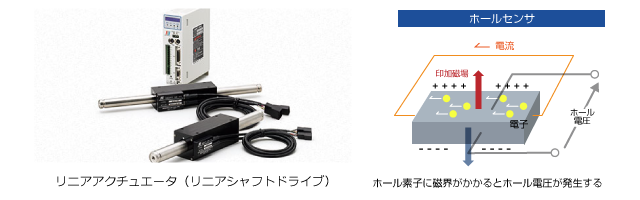
Magnetic sensors detect the magnitude and direction of magnetic fields generated by magnets, electric currents, or the Earth’s magnetic field. Miki Pulley’s linear actuators (linear shaft drives) use Hall elements to detect position information.Since position detection is possible using the magnetic flux generated by the shaft, operation is possible without an external position sensor. Furthermore, because the built-in position sensor directly detects the position of the magnetic poles, thrust is generated immediately after startup without the need for an external magnetic pole detector. The driver incorporates positioning functions, enabling relatively complex positioning operations without the need for an external controller.
Hamachan: I’ve learned that sensors play a key role even in equipment and mechanical components! I often hear about how sensors are being used to support predictive maintenance, which is a hot topic right now. I want to learn more about sensors so I can apply that knowledge to design and development!


Supervisor and Instructor
Mr. Hashimoto / Miki Pulley Co., Ltd.
Joined Miki Pulley Co., Ltd. in 1972. As a product manager, he oversaw marketing and technical operations, playing an active role both domestically and internationally. In addition, he has been involved in joint research projects not only with other companies but also with universities and specialized institutions. He is currently responsible for technical guidance and employee training.
