
Case Study| Howa Machinery, Ltd.
2026/05/07

Thanks to these custom parts made exclusively for us, we no longer have to deal with equipment breakdowns and can now make the most of our uptime!
Howa Machinery, Ltd. Design Section, Special Vehicle Division
Howa Machinery, Ltd. supplies products to a wide range of markets, including machine tools, pneumatic and hydraulic equipment, machine tool-related electronic equipment, firearms, building materials, and cleaning vehicles. Founded in 1907, Howa Machinery, Ltd. has a history spanning more than 100 years and continues to thrive across generations.
〉Issues
There was an incident where peripheral equipment was damaged during vehicle maintenance
〉Objective
We want to perform vehicle maintenance flawlessly and with consistent precision
〉Results
Now anyone can easily perform maintenance with the same precision! Problems involving damage to peripheral equipment have been eliminated, allowing us to maximize uptime!
We want to perform maintenance on the street sweeper quickly and thoroughly
We standardize the sizes of parts so that the same workers can use the same tools, thereby improving work efficiency.
We manufacture street sweepers designed to collect litter and other debris from the road and store it inside the vehicle. The waste collection bucket is mounted on top of the vehicle.To transport the trash to the bucket, it is placed on a large, diagonally mounted conveyor belt (approximately 1.5 m wide × 3 m long) and moved into the bucket.
For belt conveyors, the most common method involves securing both ends of the belt and rotating it in that position. The belt is typically made of solid rubber, which is also used in street sweepers. A wire is embedded inside the belt to prevent stretching, but since it is constantly under tension and exposed to various vibrations while traveling on roads in different conditions every day,
As a result, the belt tends to loosen, so we perform regular maintenance to adjust its tension.
During maintenance, we also loosen and tighten the numerous nuts used around the conveyor. Because there are many parts, we standardize their sizes and have the same person use the same tools to ensure efficient maintenance.
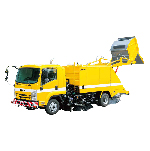
Howa Machinery, Ltd. Road Sweeper Brush-Type Road Sweeper, Model HF80H
Challenges in conveyor belt maintenance
We were experiencing issues caused by damage to peripheral equipment during maintenance
The nuts installed on the belt conveyor only needed to be small for power transmission purposes. However, to improve maintainability, we standardized the part sizes and opted for a larger size.
However, using larger-than-standard nuts led to over-tightening, resulting in problems such as belt breakage, bearing damage, and shafts bending or breaking—all caused by damage to peripheral equipment.
Although we had established standard values for belt deflection when setting belt tension, it was difficult to adhere to these standards in actual field operations, and the belts were often over-tightened.
When a single-axis robot using a brake from another company caused issues in the market and we were struggling to find a solution, Miki Pulley introduced us to a brake manufacturer, which allowed us to resolve the problem.
Since then, I had hoped to work with Miki Pulley one day. Later, when I was put in charge of developing the YK400XR small SCARA robot, I reached out to Miki Pulley, and we decided to adopt the “BXW (non-excitation type brake) model.”
Thanks to their cooperation in delivering the performance and cost we expected, we were able to develop an attractive product. During evaluation and durability testing, Miki Pulley’s development team also went above and beyond, allowing us to launch the product smoothly.Thanks to their support, the YK400XR compact SCARA robot has become a flagship product that underpins our sales. Currently, the YK400XE-4—a successor model with further improved performance over the YK400XR (and, of course, equipped with the BXW model)—is now on the market.
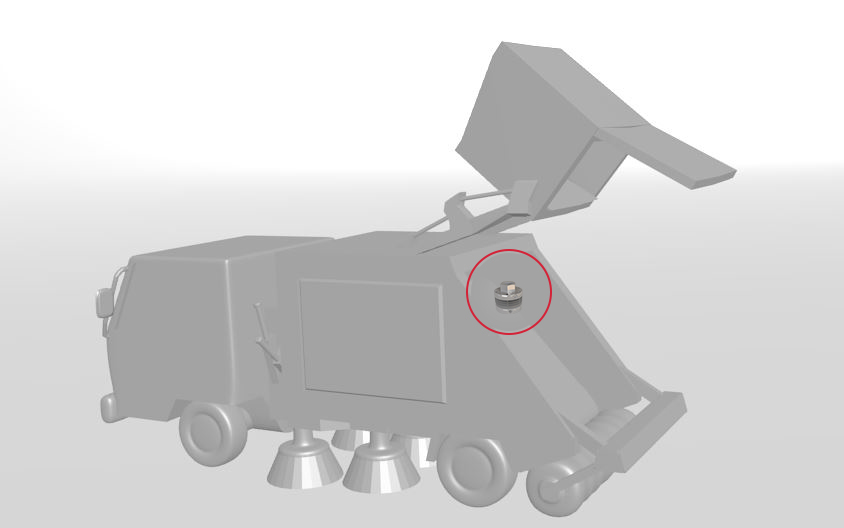
Image of the conveyor belt section of a street sweeper
We developed custom products with modified shapes to solve the problem!
To prevent the belt from becoming too tight due to over-tightening of the nut, we decided to reevaluate the nut design. That’s when we came across Miki Pulley’s “Torque Limiter (Torque Tender/Overload Protection Device).”We commissioned Miki Pulley to develop a “nut-type torque limiter” as
a custom product—a device that combines the function of the torque limiter (torque tender/overload protection device), which disconnects the input and output to protect the machine during overload, with the function of a standard nut.
By having Miki Pulley develop a nut-type version of their “Torque Limiter (Torque Tender/Overload Protection Device),” we not only solved the initial problem of conveyor belt damage caused by over-tightening the nuts, but also made it possible for anyone to perform maintenance with the same level of precision.
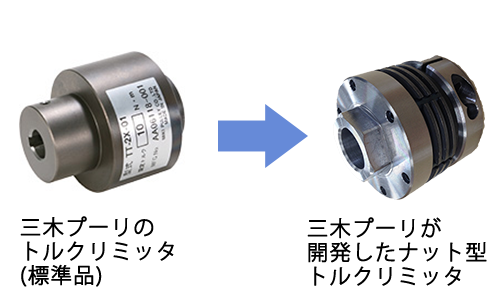
Sample