How to Prevent Looseness and Sagging in Machine Belts and Chains and Extend Their Service Life
2026/05/07
Do you perform maintenance on the belts and chains of your machinery and equipment?
Failure to perform maintenance can lead to loosening and sagging! In this article, we’ll explore the causes of these issues and introduce ways to extend the lifespan of your belts and chains with minimal maintenance!
What causes belts and chains on machinery to become loose or slack?
You may hear unusual noises coming from the belt or chain, or notice that they have become loose or slack.
What causes these issues, and what adjustments or measures are needed to address them?
The first thing you need to know is how power is transmitted
Before we look into the causes of slack or looseness in belts and chains, let’s first consider how the machine transmits power.
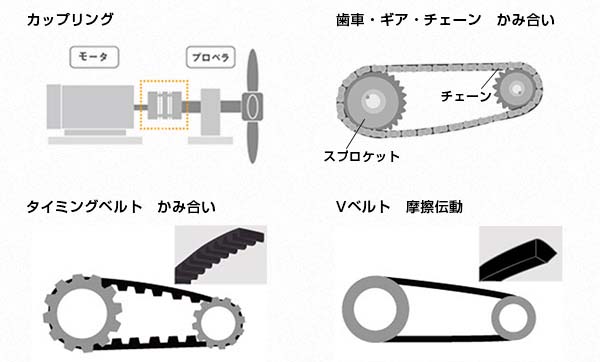
In addition to couplings, belts and chains are commonly used to transmit power from the drive side. Furthermore, the transmission methods for belts and chains vary by type and can be divided into two categories: "meshing transmission" and "friction transmission."
[Methods of Power Transmission]
Causes of a loose belt
A loose belt is caused by improper tension, shock loads from starting and stopping, or belt elongation due to aging; this results in "slippage," which leads to reduced transmission efficiency and a shorter service life due to heat generation.
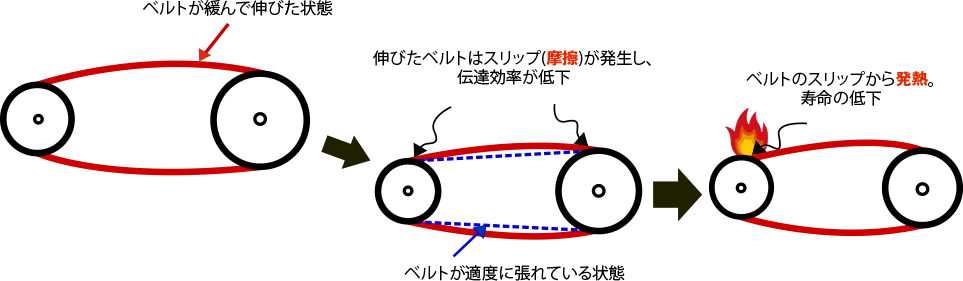
| ■What is belt slack = belt stretch? | Belt slack occurs when the belt is not tensioned to the proper level. Since belt drives rely on the friction between the belt and the pulley, it is essential to maintain the proper tension. However, if the tension is lower than the proper level, the belt becomes slack; this slackening is further exacerbated by slippage and heat generation. Additionally, it is said that the belt length stretches by approximately 5% over time until the end of its service life. (Example) If the belt span is 1000 mm, 1000 mm × 2 × 5% = 100 mm |
|---|
Causes of Chain Slack
Chain slack is caused by the chain being too tight or by initial stretch (0.1%), and can lead to chain skipping and vibration.
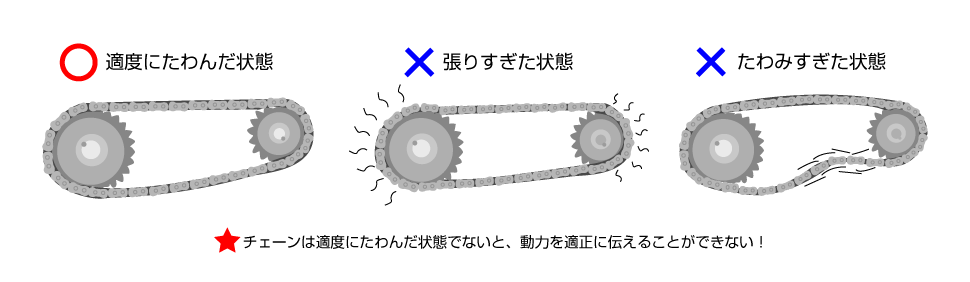
| ■What is tooth skipping? | This phenomenon occurs when the chain becomes significantly slack, causing the chain to slip off the sprocket teeth and rotate freely; it is particularly likely to occur on the lower sprocket when the chain is mounted vertically. |
|---|
Looseness and sagging? The "Rosta/Tensioner" is the solution!
How to Fix a Loose Belt
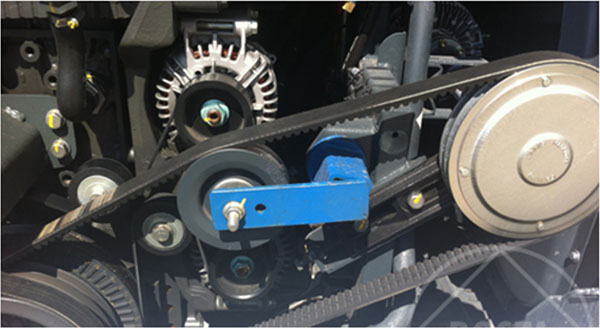
You can resolve belt slack by using a tensioner to maintain proper tension.
To maintain proper belt tension, it is necessary to select a belt that is compatible with the machine and to adjust the tension regularly.
Using a tensioner allows you to maintain the proper tension without the need for maintenance. This also significantly extends the service life.
| ■What is Rosta? | A versatile, multifunctional cushioning device that combines three functions—spring, damper, and bearing—into a single unit. There are four product types available, including tensioners. |
|---|
| ■What is a tensioner (Rosta/Tensioner)? | A component designed to maintain proper belt tension, preventing power transmission losses caused by slack or slippage. It suppresses the swaying, vibration, and impact caused by a stretched belt, improves transmission efficiency through proper tension, and extends the belt’s service life. |
|---|
How to Fix a Sagging Chain
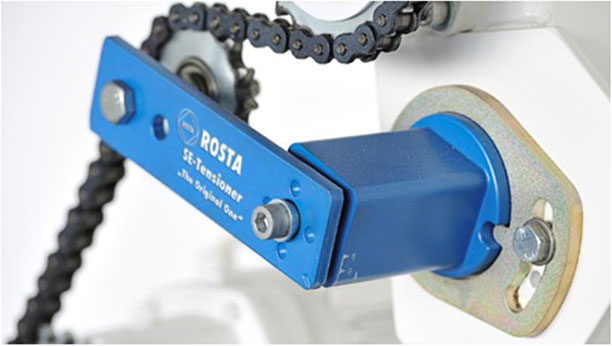
Loose or sagging chains can be fixed by using a chain tensioner to ensure the chain is properly tensioned.
To prevent chain vibration and skipping, the chain also requires regular maintenance.
Using a tensioner allows for maintenance-free tension adjustment.
What Is a Rosta/Tensioner? A Comprehensive Guide
Features of the Rosta/Tensioner
A Rosta is a mechanical component commonly referred to as a "swing, anti-vibration, or cushioning device."
This versatile, multifunctional cushioning device reliably transmits oscillatory motion, absorbs vibration and noise, and offers excellent durability and resistance to impact loads.
■Features of Our Tensioners
- It is maintenance-free because it automatically maintains the proper tension in belts and chains.
- Rosta's unique rubber construction automatically absorbs swaying, vibration, and impact, helping to extend the life of belts and chains!
- Fewer parts and easy to install!
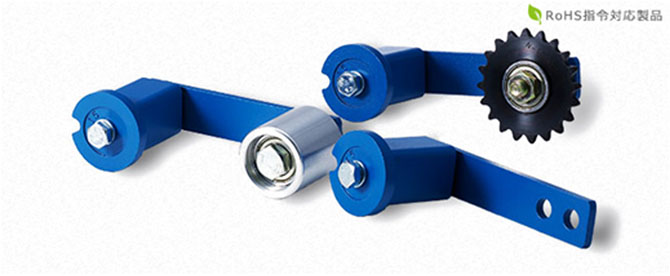
How to Install a Rosta/Tensioner
Install the pulley/tensioner at an angle between 0 and 15 degrees to ensure the belt or chain is properly tensioned.
In addition, adjusting the mounting position to align with the drive unit can help reduce vibration and other issues.
Always install the tensioner on the slack side of the chain or belt. If the unit rotates in both directions, install tensioners on both sides.
When purchasing belts or chains, please check the size and choose items that are easy to tighten.
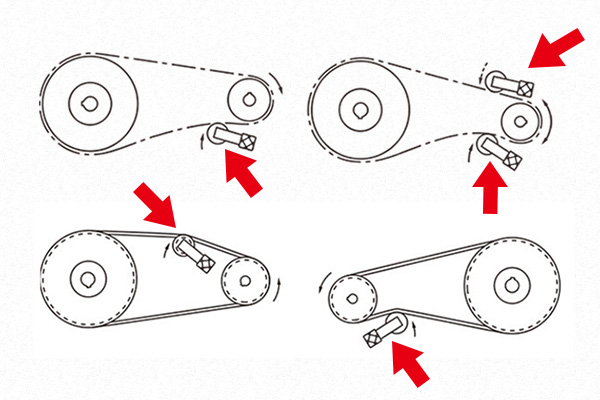
★When applying tension from the outside: Set the tensioner on the side of the smaller sprocket (pulley)
★When applying tension from the inside: Set the tensioner on the side of the larger sprocket (pulley)
Case Studies of Rosta/Tensioner
① Packaging Machine Manufacturer (Manufacturing Technology, Design and Development) [Case
Study]
Maintaining tension in the power transmission system
(belt drive) of an automatic quantitative bagging machine
[Reason for Adoption]
Previously, we used a fixed-type tensioner and
had to adjust it every time slack occurred.
This tensioner can
automatically adjust the tension to compensate for slack, making maintenance much easier!
② Semiconductor Manufacturing Equipment (Design) [Application
Examples]
Conveyor Chain Tensioner
[Reason for Adoption]
We chose this product because we were impressed by its ability to maintain
proper tension even on chains that expand and contract due to heat. We
also appreciate
its space-saving design and the fact that it can be installed with just a single bolt.
③ Food Machinery Manufacturer (Design and Sales Engineering)
[Application Examples]
Dryer (Vibrating Conveyor)
[Reason for Adoption]
We were previously using a spring-type system, but by replacing it with a fully
integrated loss-tensioner, we reduced the number of parts and made
installation easier. We were also able to eliminate rattling
noises.
We will recommend the right product for you