
Frequently Asked Questions
This page provides answers to frequently asked questions. If your question is not listed here, or if you cannot find the information you need, please contact us using the
contact form.
| *The information below will be added to and updated as needed. |
Products
Couplings
ETP Bushings and POSI LOCK (friction locking devices)
ETP Bushings and POSI LOCK (friction locking devices)
Electromagnetic Clutches and Brakes
Belt-Type Speed Changers and Reducers
Torque Limiters
ROSTA
Export Control Classification
Other
Couplings
When a coupling is supplied with standard bore machining, are set-screw holes and set screws included? (set screws, grub screws, screws, locking screws)
Set-screw holes are machined in the quantity and size shown in the catalog, and the set screws are supplied with the product. For details, please request a product catalog or use the model index search to find the product and confirm the specifications.
If the mounting shaft for a coupling has a keyway, what happens to the allowable torque?
The allowable torque does not change if the coupling is used with proper attention to the shaft mounting position, even when a keyway is present.
Can the coupling fastening section (bore) be made as a spline?
It depends on the coupling type and spline type. Please contact us using the contact form.
How should the shaft insertion length for a coupling be determined?
Although it depends on the coupling type, as a rule the shaft should be inserted across the full length of the hub (flange). If the shaft insertion length is extremely short, reduced holding force may cause slipping, prevent proper fastening, or deform the hub so that later insertion becomes impossible.
Some couplings use set screws for shaft fastening, but vibration may cause them to come loose. Is there an effective countermeasure?
As a special measure, two set screws can be used in one threaded hole, for example. The best method depends on the bore diameter and machine specifications, so please contact us for review.
Can the size or number of keyway set screws be changed? (Example: AL-070 H17, 2-M4 to 1-M6)
This is possible, but it is handled as a special specification.
Please use the contact form and provide the details.
SERVOFLEX (metal disc spring couplings)
What is the paint applied to bolts on products such as SFC?
Depending on production conditions, products may be manufactured either manually or by machine.
When production is performed manually, paint is used as a visual check to confirm that there are no problems with torque-wrench tightening.
What is the minimum shaft insertion length for SFC couplings?
As a rule, insert each mating shaft so that it contacts the shaft across the full length of the coupling clamp hub (LF dimension).
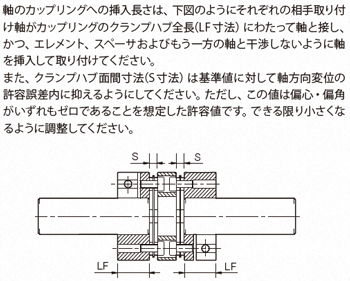
In some cases, the coupling can still be used without issue even if the insertion length is not exact. In that case, please contact us using the contact form.
Can an SFC be mounted even if the mating shaft has a keyway?
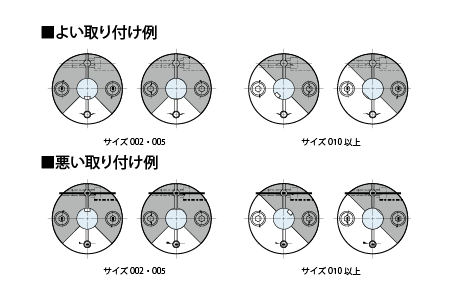
A round mating shaft is the standard requirement. If a non-round shaft must be used, pay close attention to the shaft mounting position as shown below.
Depending on the shaft mounting position, the coupling body may be damaged or shaft holding force may decrease.
To obtain full coupling performance, we recommend using a round shaft.
Can clamp-type and wedge-type fastening be combined on an SFF coupling?
Yes. Specify the bore diameter and fastening type for each hub.
Can clamp-type and wedge-type fastening be combined on an SFM coupling?
Yes. Specify the bore diameter, fastening type, balance grade, and rotational speed for each hub.
Can a keyway be added to clamp-type SFF or SFM couplings?
This can be reviewed depending on the bore diameter and keyway dimensions (width, height, and tolerance). Some specifications may not be possible.
Can two keyways be machined into an SFH coupling?
A review is required each time depending on the keyway specifications, such as geometric tolerance and position. Please describe the desired specifications and contact us using the contact form.
One SFH unit was delivered in two packages. Since only one unit was ordered, is this an overdelivery?
Depending on the SFH size, one unit may not fit in a single package. In such cases, it may be shipped in two packages, but this is not an overdelivery of units.
Why is allowable eccentricity not listed for SFH-S, while it is listed for SFC and SFF?
In theory, even single-element SFC and SFF types cannot tolerate eccentricity. However, because SFC and SFF are shipped assembled, unlike SFS and SFH which are shipped as parts, shaft-center adjustment can be difficult. Therefore, allowable eccentricity (error) is provided within a range that does not affect performance.
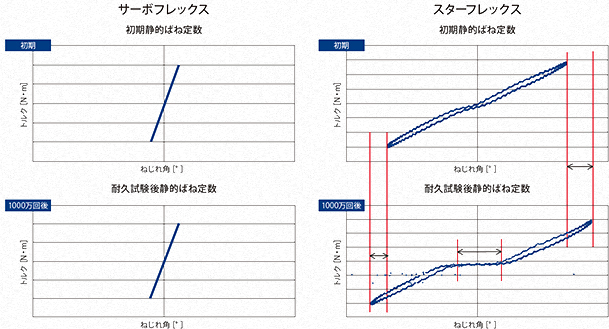
What durability and aging characteristics does SERVOFLEX (metal disc spring coupling) have?
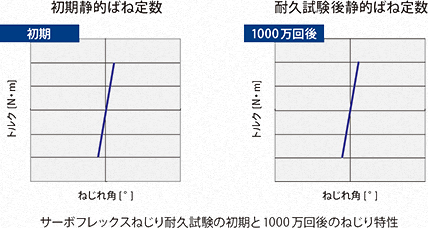
We conduct torsional durability testing under loads above the allowable torque. SERVOFLEX has passed 10 million cycles in this test, which is the metal fatigue limit. Because it is made entirely of metal materials, age-related deterioration is extremely low, enabling high-precision torque transmission over a long period.
Runout occurs on the driven shaft after a coupling is installed. What causes this?
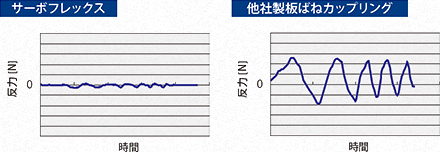
Driven-shaft runout caused by a coupling is mainly due to shaft reaction force from insufficient alignment. All SERVOFLEX series metal disc spring couplings are assembled using high-precision dedicated jigs, giving the left and right bores high concentricity. Because shaft reaction force is extremely small, driven-shaft runout can be kept to a minimum.
Noise or vibration occurred while using a metal disc spring coupling. What countermeasures are available?
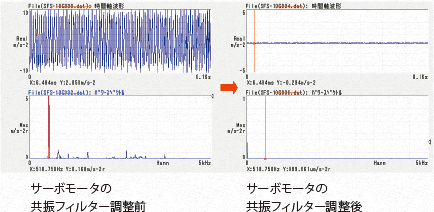
For servo motors, noise and vibration can be suppressed by setting the mechanical resonance suppression filter in the control system to the relevant natural frequency. For stepping motors, vibration can be absorbed or suppressed by shifting the operating speed or using a STEP-FLEX coupling with high damping performance.
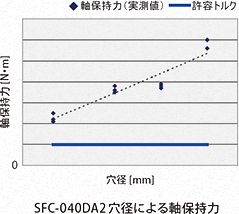
Can sufficient torque be transmitted with clamp-type shaft fastening?
Our torque transmission testing uses a sufficient safety factor, so at the allowable torque listed in the catalog, the fastening section will not slip because of the fastening method. Keyway machining on clamp hubs is available; customers who require this should refer to the keyway machining option.
SPAFLEX (jaw couplings)
Do AL pilot-bore products already have a bore?
No. A center hole like the one shown below is machined instead.
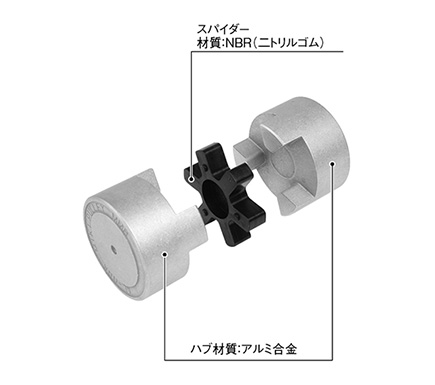
STARFLEX (jaw couplings)
What is the model number of the ALS element?
The model is EL. For details, see ALS element only.
What is the service life of STARFLEX?
When power transmission is the primary purpose, a service life of 10 years or more can be expected if the product is selected properly according to the selection procedure in the catalog. Service life varies depending on the operating environment and conditions, especially operating temperature and mounting error. Please contact us for details.
Can the product be used above the normal operating torque?
Use above the normal operating torque is acceptable up to 10 times per day with 8 hours of operation per day, provided the maximum torque is not exceeded. This assumes starting torque for motors with infrequent starts and stops.
What is a loose-fit element?
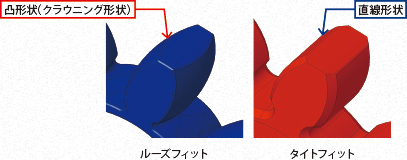
This is an element whose torque transmission surface has a convex, crowned shape, allowing greater permissible mounting error. The fit with the hub is also looser, making assembly easier and reducing work time.
Does STARFLEX no-backlash performance change over time?
STARFLEX achieves zero backlash by applying pre-compression to the element, so zero backlash may no longer be maintained as the resin ages. If long-term zero-backlash use is required, we recommend using a larger correction factor based on the nature of the load. For longer-term high-precision control, we recommend the SERVOFLEX series metal disc spring coupling.
The resin part (element/spider) of an ALS (STARFLEX) coupling may be exposed to solvent. Is this acceptable?
A case-by-case review is required depending on the solvent type. Please specify the solvent you plan to use and contact us using the contact form.
Can the overall length of an ALS (STARFLEX) coupling be changed?
It is possible to shorten the hub. Please consult us each time regarding the desired specifications. Lengthening the hub is not supported. We can propose the most suitable coupling for your application using another coupling such as SFC, so please contact us using the contact form.
CENTAFLEX (rubber and resin couplings for prime movers)
Resonance occurs in equipment driven by a diesel engine. Are there any countermeasures?
When a diesel engine is used as the drive source, resonance occurs when the natural torsional frequency of the entire torque transmission system matches the frequency generated by engine speed. Engine couplings do more than transmit rotation and absorb vibration; they also help move the resonant speed away from the operating range. If a resonant speed exists, changing the torsional spring constant of the coupling, such as by changing the coupling or rubber hardness, can shift the resonant speed away from the operating speed. In models with low torsional spring constants using natural-rubber elements, such as CF-A and CM, the resonant speed tends to appear below low idle. In models with high torsional spring constants, such as CF-H, it tends to appear above high idle speed.
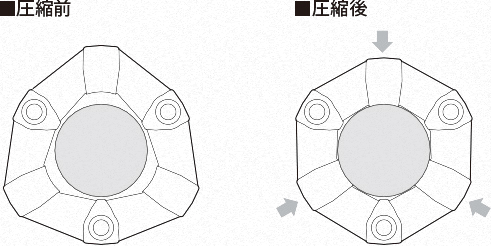
What is the pre-compression structure of the CF-A model (rubber and resin coupling for prime movers)?
Rubber has a characteristic in which service life is longer when it is used in compression rather than tension. Even in compression, service life is further improved when force is applied after the rubber has already been compressed to some extent; this initial compression is called pre-compression. The CF-A model is assembled with pre-compression applied to the rubber body. The compressed portions have long service life, and the portions that would be pulled do not enter a tensile state unless torque above a certain level is applied, resulting in long overall service life.
Heat effects and maintenance for rubber couplings
When natural rubber is exposed to heat, oil on the surface is lost, elasticity decreases, and the rubber hardens. The progress of hardening depends on temperature. If a CF-A used inside an engine housing is affected by heat, hardening begins at the surface of the rubber body. When torque is applied to that area, cracks start from the hardened layer and damage progresses. As a maintenance guideline, we recommend replacement when rubber hardness has increased by about 15 Hs compared with the unused condition.
About the Center Lock mechanism
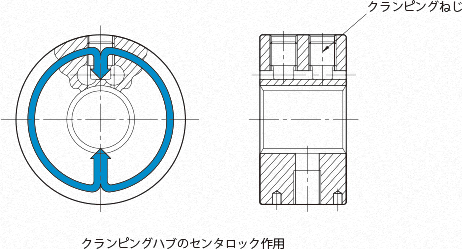
When mounting the hub on the shaft, the Center Lock mechanism can be used. Tightening the clamping screw deforms the spline section of the clamping hub and presses it against the spline section of the shaft, fully fixing the hub and spline shaft together. Depending on the size, tightening the clamping screw to the specified torque generates approximately one ton of axial holding force per clamping screw. Therefore, in normal use, the fastening level is fully adequate.
Should the CF-A bolts be replaced together with the rubber body?
Replacement is recommended because the bolts have a microcapsule coating for loosening prevention.
How many times can CF-A bolts be retightened?
Retightening or reassembly over a short period is possible, but the loosening-prevention effect will decrease. If the bolts have been used for a certain period, replacement is recommended.
The CF rubber body is tight and cannot be replaced easily. Is the purchased rubber body correct?
To improve durability, the CF-A model has a structure in which pre-compression is applied. As a result, assembly may be somewhat difficult.
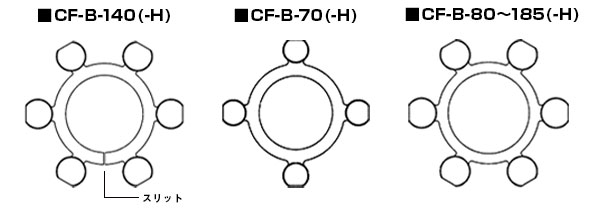
Some CF-B elements have a slit depending on the size. Is this normal?
Yes, this is normal. The 140 and 140-H elements have a slit.
What happens if the CENTAFLEX series resonates?
If resonance occurs, internal heat generation may cause melting damage, and the product may fail within a few minutes.
What should I note when specifying bore diameters for CENTAFLEX couplings at the time of order?
When specifying bore diameters, check the "Ordering Information" section of our catalog and list the cylindrical hub bore diameter (d1) followed by the flange hub bore diameter (d2) after the model number.
Note that the minimum and maximum bore diameters differ between the cylindrical hub side and the flange hub side.
The minimum and maximum bore diameters for each side are listed in the dimensions section, so please check that information.
Please carefully check the notes for each item.
Does the CENTAFLEX clamping hub specification provide zero backlash?
The clamping hub and shaft are completely fixed by the Center Lock action, so there is no backlash.
However, if the clamping screw tightening torque is lower than the specified torque, sufficient holding force may not be obtained and backlash may occur.
Use a torque wrench or similar tool to tighten to the specified torque. Also note that for products that have backlash by design, the backlash will not be eliminated.
The CF-B-140 size element has a split. Is this due to a defect or deterioration?
Only this size is originally supplied with one cut. This makes it easier to replace the element while keeping the hub fixed.
ETP Bushings and POSI LOCK (friction locking devices)
Can resin hubs be used with ETP Bushings or POSI LOCK?
No, they cannot be used.
ETP Bushings
What is the allowable speed for ETP Bushings?
This depends on the ETP size and the dimensions of the hub to be mounted, but use at around 3,000 min-1 is generally acceptable. Please contact us for high-speed applications.
What is the durability of ETP Bushings?
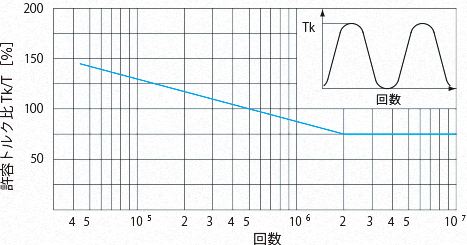
When the allowable torque is applied cyclically to an ETP Bushing, fatigue life is approximately 500,000 cycles. When 75% of the allowable torque is applied cyclically, fatigue life is virtually permanent.
How much does ETP expand when pressure is applied?
It varies depending on the material and the shape of the mating hub.
There is no single answer. When selecting an ETP product, always follow the specified tolerances.
The specified mounting tolerances for each ETP product are provided in the selection data.
At the end of each model page, there is a page titled "Design Checkpoints." You can confirm the specified mounting tolerances there.
What are the components of the pressure medium (grease)?
It varies by model.
Some models use high-safety food machinery lubricant (NSF H1 registered) instead of oil (ETP-E-R model).
What effect does ETP grease have on the human body? Is it safe if it comes into contact with food?
It varies by model. Please contact us using the contact form.
Some stainless steel models use high-safety food machinery lubricant (NSF H1 registered) instead of oil (ETP-E-R model).
Are there any precautions for the hub on which an ETP Bushing is installed?
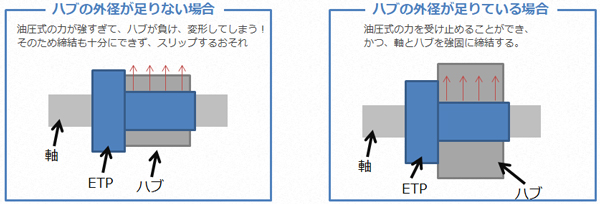
As shown in the figure below, if the outside diameter of the hub is insufficient, the hub may deform under the hydraulic force. When selecting an ETP Bushing, always confirm that the minimum outside diameter of the hub is sufficient.
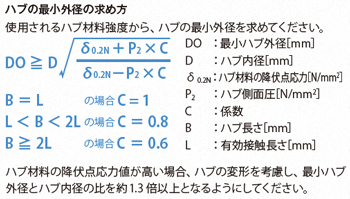
Refer to the formula below to determine the minimum outside diameter of the hub.
Can it be used if the shaft or hub has a keyway?
It can be used if the machined keyway is completely filled with metal epoxy putty or similar material and then shaped properly. If used with the keyway left as-is, the sleeve may deform and become impossible to remove.
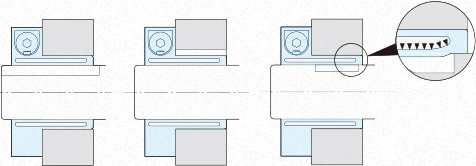
Can it be used if the shaft or hub does not cover the full sleeve length?
Select a short-sleeve specification, or contact us, so that the shaft and hub cover the full sleeve length. In areas where the sleeve is not in contact with the shaft or hub, sleeve deformation is not restrained. This can increase deformation, cause plastic deformation of the sleeve, or prevent sufficient friction force from being obtained, resulting in failure to meet the specified values.
Can the allowable torque still be transmitted when thrust load is applied?
The listed allowable torque and allowable thrust force are the maximum allowable values when each acts independently. When torque and thrust force act at the same time, calculate the combined load and confirm that it is below the allowable torque.
Can an ETP Bushing be reused after it has slipped once?
Reuse is possible after minor slipping, depending on the degree of slip. Before reuse, check that the surfaces of the ETP Bushing, shaft, and hub are not scratched and that the ETP Bushing body is not deformed. The cause of the slip must also be removed before reuse.
Can the ETP pressure screw be replaced? Is it sold separately?
We do not sell or replace the pressure screw. If the pressure screw is removed, air will enter the hydraulic mechanism and the locking function will be lost, so please do not replace it yourself.
Is the allowable torque of ETP lower than that of mechanical types?
This depends on the shaft diameter being used, so it cannot be said that the allowable torque is always lower. ETP products fasten by contact over the mating surface. Therefore, as shaft diameter increases, the allowable torque of ETP products becomes higher. Please see the ETP product specifications for details.
What IP rating does ETP-E-R correspond to for waterproofing?
It does not conform to an IP rating. It is a stainless-steel specification designed to resist rust, so please do not use it primarily for waterproofing purposes.
Are ETP-K, ETP-G, and ETP-D types no longer available?
The model numbers have been changed to PSL-K, PSL-G, and PSL-D. For PSL, please see the PSL product page.
How much corrosion resistance do ETP-E-C and ETP-T-C provide? Is there any documentation on their rust-prevention effect?
Electroless nickel plating provides better corrosion resistance than the standard specification, but the rust-prevention effect varies depending on the operating environment. For use in special environments, please contact us using the contact form.
Electromagnetic Clutches and Brakes
Can dust covers be made for clutches or brakes?
At present, dust covers are available only for the BXW model.
In addition to work volume (wear), what factors affect the service life of clutch and brake products?
In addition to work volume, service life is affected by electromagnetic coil life due to thermal deterioration and by mechanical life such as springs. Electromagnetic coil life corresponds to allowable energization time. Mechanical life is the number of no-load ON/OFF operations of the clutch or brake product. For details, please use the contact form.
Can clutch or brake products be used outside the specified operating environment?
This can be handled as a special specification. For details, please use the contact form.
Can torque be controlled with an excitation-actuated brake?
Some brakes can control torque by changing the current, but we do not handle such products.
How many operations are allowed for the release lever?
This varies by model. The lever is not designed for continuous operation, and excessive operation may cause deformation or other issues. As a guideline, we recommend limiting operation to several dozen times.
Do the stator lead wires of clutches or brakes have polarity (+/-)?
No.
Spring-Applied Brakes
No standard product meets the torque, response, or other requirements. Is customization available?
Various customizations are possible, such as using an over-excitation power supply, using inrush current at motor startup, or changing the friction material. These can increase torque, improve response, extend total work capacity (service life), and reduce heat generation. Please contact us for details.
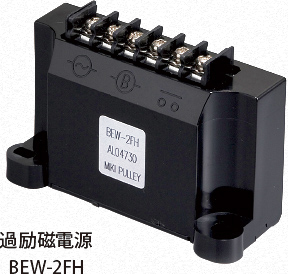
Can you provide a solution when dimensional constraints prevent installation of a standard product?
Yes. We have many examples, such as reducing thickness while maintaining torque. Depending on the conditions, it may be possible to reduce thickness to about half that of a standard product at the same torque. Please contact us for details.
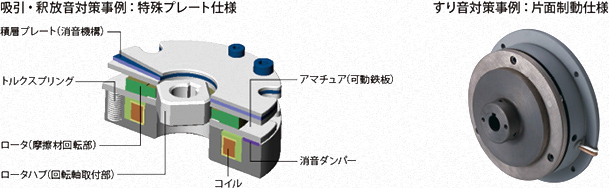
What noise countermeasures are available?
Noise from spring-applied brakes includes 1) rattling caused by slight vibration during rotation, 2) armature attraction and release noise, 3) friction noise during braking (squeal), and 4) rubbing noise during drive rotation when the brake is released. Countermeasures are available for each. The figure below shows one example.
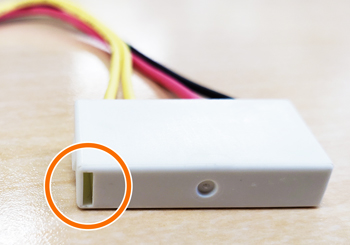
What are the grooves on the back side of the BXR-LE power supply?
The power supply can be fixed in place, for example by mounting it to a wall with brackets. These grooves are provided for attaching the brackets needed for that mounting.
Clutch and Brake Power Supplies
What is the input current of BES?
It varies depending on the load, but the rated current is as follows.
BES-20-□□-1 1.6 A
BES-40-□□-1 3.2 A
BES-20-□□ 0.8 A
BES-40-□□ 1.6 A
Why is BEH not a recommended power supply for spring-applied brakes even though it outputs DC24 V?
BEH is an ultra-high-speed control power supply designed for high-speed, high-response control of excitation-type clutches and brakes. Spring-applied brakes are applied by springs, so they cannot be controlled electrically at high speed or with high response. For that reason, BEH is not recommended as a power supply for spring-applied brakes.
Belt-Type Speed Changers and Reducers
How do I remove the belt from a belt-type speed changer unit? (Excluding AHS and RWP)
If possible, run the motor, turn the speed-change handle counterclockwise, and stop it at the maximum speed setting. Then turn the speed-change handle clockwise; the belt will loosen and can be removed. (Video)
How do I install the belt on a belt-type speed changer? (Excluding AHS and RWP)
Set the motor-side pulley to the minimum speed. Place the belt on the motor-side pulley. Hook the belt onto the driven-side pulley and rotate it half a turn to install the belt. (Video)
How do I remove the driven-side pulley PE (07 or larger) on the ANS type?
The adapter is tightened and fixed with the hex socket head bolt in the center of the pulley. Loosen that bolt to remove the pulley.
Can only the motor or reducer of a hollow-shaft unit be purchased?
As a rule, we do not offer this.
What is the rated current of ANW?
The value is the current for the motor alone. A label showing the current value is attached to the side of the motor, so please refer to that label.
Can the oil in RWM be changed?
No, we do not offer this.
Zero-Max
Can Zero-Max units be repaired or traded in?
No, we do not offer this.
Torque Limiters
How do I replace the spring in a Torque Tender (torque limiter)?
Spring replacement requires disassembly, so customers should not replace the spring themselves.
ROSTA
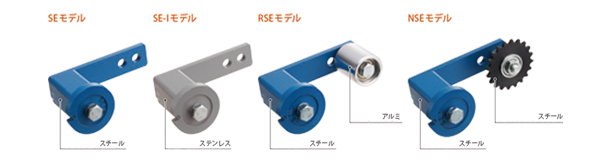
What materials are used for each part of a ROSTA tensioner?
Please refer to the information below.
Are mounting bolts and nuts included with the RA pulley idler?
Yes, they are included.
Are mounting bolts and nuts included with the N sprocket idler?
Yes, they are included.
Export Control Classification
How can I download an Export Control Classification Certificate?
You can download it from the Export Control Classification Certificate Issuance page.
What should I do for products not listed in the export control classification list on the website?
Please use the contact form and include the product name and model number. Because these are not standard items, confirmation takes time; even if the request is accepted, the lead time may be two weeks or longer.
For externally manufactured products, the request must be made to the manufacturer, so it takes about one month. If you are in a hurry, please contact the manufacturer directly to check whether the document can be issued from the manufacturer website or by other means.
For our products, the response will be the same as the export control classification result shown on the website. Responses from manufacturers will be submitted as received.
How are parts and optional products classified for export control?
Classification information for parts such as elements, rubber bodies, and speed-change belts, as well as optional products such as ROSTA, clamps, brackets, and idlers, can be obtained from the website. Please note that the Export Control Classification Certificates on the website do not cover all parts and optional products.
How are discontinued or replaced products classified for export control?
Products may be discontinued or replaced due to performance improvements or replacement by new products. Some Export Control Classification Certificates also list old model numbers, so please check the certificate.
What does the enforcement date of the law shown on the Export Control Classification Certificate mean?
This is the date on which a legal revision related to export control classification came into force. At Miki Pulley, classification is checked each time notice is received that the latest legal revision will take effect. Depending on the content of the revision, however, the enforcement date may not be listed. We do not accept requests to change or delete the enforcement date.
Can classification be performed under Appended Table 2 of the Export Trade Control Order?
Goods listed in Appended Table 2 include diamonds, blood products, nuclear source materials and nuclear fuel materials, agricultural chemicals, and pharmaceuticals. These are unrelated to products handled by Miki Pulley, so we do not provide classification under Appended Table 2.
Are parameter sheets or item-by-item comparison tables available?
We do not issue them.
Can you prepare it in a specified format?
In principle, an Export Control Classification Certificate is a document prepared by the customer. Preparing it in a specified format or adding information would mean that we are acting on the customer behalf, which could create liability issues due to errors and inconvenience the customer. Therefore, we do not accept such requests.
Can drawing numbers or similar information be added to the Export Control Classification Certificate?
Customer-specific information such as drawing numbers and part numbers is not managed by us. It also does not need to be added to the Export Control Classification Certificate. Because errors could occur, we do not accept such requests.
Why does the model number on the Export Control Classification Certificate include an asterisk (*)?
Specifications that do not affect identification of the product itself are shown simply as an asterisk (*). Examples include bore diameter combinations, differences in shaft fastening methods, and special numbers assigned according to customer requirements. Therefore, even if the model number contains an asterisk, it has no effect on the export control classification result. For that reason, we do not accept requests to show the full model number on the certificate. Customers may enter the full model number on the certificate themselves if necessary.
Other
How do I request a REACH survey?
Please use the contact form and enter the model number subject to the REACH survey request. Submitting the request through the website is faster than requesting it by phone.
Where can I purchase your products?
For small-quantity orders, please use the Miki Pulley official online shop. For large-quantity orders, please use the contact form. If you would like to purchase through another distributor but do not know which distributor to contact, please use the contact form.
How can I request STEP data (CAD data)?
CAD page and instruction manual page are available for download.
The CAD format provided is as follows.
3D CAD: STEP format
For formats other than the above, please consult us using the contact form.
Note: For 3D CAD, we can consider preparing IGES, binary, or Parasolid formats.
Do you sell directly?
We sell directly through the Miki Pulley official online shop or through our sales staff. We can suggest the best purchasing method for your needs, so if you are considering purchasing a product, please contact us using the contact form.
Which shipping carriers can be used?
Normally, Seino Transportation and Fukuyama Transporting can be used.
Do you handle timing pulleys or V-pulleys?
We do not handle these products.
Can the model number be identified from the serial number?
As a rule, this is not possible.