
What Is a Decarbonized Society and the Future of Energy? | An Easy-to-Understand Webinar
2026/05/07
What Are a Decarbonized Society and the Energy of the Future? A Veteran Engineer Explains It in Simple Terms!
Is Hydrogen the Energy of the Future? What Is a Decarbonized Society?
What Is a Decarbonized
Society (Carbon Neutrality)?
Hama-chan: Professor Hashimoto! I saw a car running on hydrogen on TV the other day! I
heard that hydrogen is an eco-friendly energy source for the future. I’d love to learn more about how it works and why it’s being used!
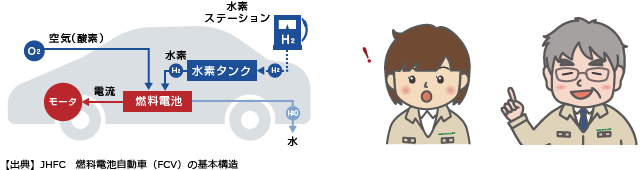
Mr. Hashimoto: That’s a fuel cell vehicle (FCV) that runs on hydrogen.It’s an electric vehicle that generates electricity through a chemical reaction between hydrogen and oxygen, and uses that electricity to power the motor. This technology is
being applied to trucks and buses as well, and its practical implementation is progressing. Recently, there was a lot of buzz about hydrogen-engine vehicles—which run on hydrogen itself instead of gasoline—competing in endurance races.
Although there are various challenges, there are also plans to use hydrogen to drive turbines and generate electricity. Hydrogen is one of the new options for “carbon-free energy.”
Hama-chan: I see. So hydrogen energy is expected to be utilized in a wide range of fields, such as power generation, transportation, and industry. Why have electric vehicles (EVs) and fuel cell vehicles (FCVs) suddenly become such a hot topic?
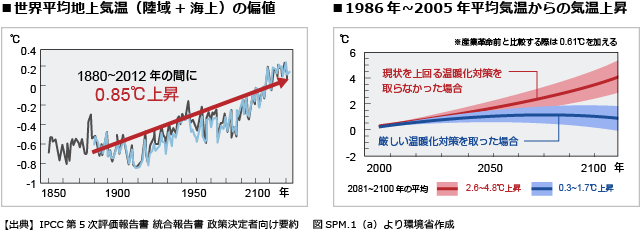
Professor Hashimoto: That’s a good question. It’s closely related to the transition to a decarbonized society and Japan’s energy issues. One of the problems we’re facing is global warming, right? The cause of that is greenhouse gases, primarily carbon dioxide (CO2). Once CO2 is released into the atmosphere, it remains there semi-permanently unless absorbed by plants or the ocean, and it has a massive impact on global warming.It’s said to be the cause of extreme
weather events around the world. To preserve the global environment, we need to realize a decarbonized society by reducing greenhouse gases (CO2) as much as possible.
Hama-chan: So, the Japanese government has announced that it aims to “achieve a carbon-neutral, decarbonized society by 2050, with net-zero greenhouse gas emissions.” Carbon neutrality means offsetting greenhouse gas emissions with absorption to achieve a net-zero balance, right?
Professor Hashimoto: That’s exactly right. You’ve really done your homework. There are 125 countries and one region that have declared their commitment to achieving carbon neutrality by 2050. Japan has fallen behind the rest of the world, but with this declaration as a catalyst, we plan to transform our industrial structure and achieve emissions reductions. Decarbonization has become a critical issue for the industrial sector as well.
What will the future of energy look like?
What Is Japan's Energy Policy?
Professor Hashimoto: For Japan, which has almost no energy resources of its own, energy policy is a very important issue. The policy has basic guidelines, and the 6th Basic Energy Plan is scheduled to be released this year (2021).The guidelines
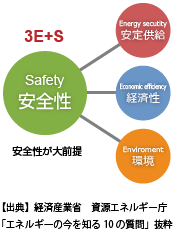
of the previous 5th Plan were based on the “3E” principles: stable energy supply (achieving approximately 25% by fiscal year 2030), environmental compatibility (a 26% reduction compared to fiscal year 2013 by fiscal year 2030), and improved economic efficiency (9.2–9.5 trillion yen by fiscal year 2030). In 2014, following the Great East Japan Earthquake, "Safety" was added to these principles, and the basic principles of energy policy became "3E+S," which aims to achieve the "3E" goals while prioritizing safety as the overarching premise.
The Energy Mix for 2030
Professor Hashimoto: The 5th Basic Energy Plan sets the goals of “reducing greenhouse gas emissions by 26%” and “reliably achieving the energy mix.” The reason we need an energy mix is that there is no single
, perfect method of power generation. To address the challenges of each method, we need to use a balanced mix of various power generation methods to ensure a sustainable approach over the medium to long term.
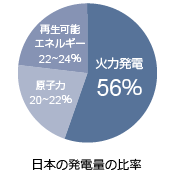
Hama-chan: So Japan still relies heavily on thermal power generation, doesn’t it? It seems the energy mix will become increasingly important for curbing CO2 emissions.
Professor Hashimoto: That’s right. Also, within thermal power generation, technological development to reduce CO₂ emissions from liquefied natural gas (LNG) is progressing. Research is also underway on CO₂-free power generation using hydrogen gas and ammonia. I’ve summarized the various power generation methods in a table.
| Power Generation Methods | Power Generation Mix | Stable Energy Supply | Environmental Conservation | Operating Characteristics | ||
|---|---|---|---|---|---|---|
| 2018 | 2030 | CO2 Emissions (g-CO2/kWh) | ||||
| Approximately 1.0512 trillion kWh | Approximately 1.065 trillion kWh | During extraction, construction, and transportation | During power generation | |||
| Coal (thermal) | 32% | 26% | • Fuel reserves are widely distributed throughout the world | ■79 | ■■■■■864 | • Gentle output fluctuations are possible • Output adjustments in response to demand fluctuations are easy |
| Oil (Thermal) | 7% | 3% | • Fuel reserves are concentrated in the Middle East | ■43 | ■■■■695 | |
| Natural gas (thermal power) | 38% | 27% | • Less concentration of fuel reserves | ■123 | ■■■476 | • Capable of adjusting output to meet fluctuating demand |
| Nuclear | 6% | 20–22% | • Excellent storage capacity • Fuel can be recycled | 19 | No CO2 emissions during power generation | • Output remains constant |
| Solar | 6% | 7% | • No risk of resource depletion • Dependent on natural conditions | ■38 | • Output fluctuates significantly depending on natural conditions | |
| Wind | 0.70% | 1.70% | 26 | |||
| Hydroelectric | 7.70% | 8.8–9.2% | _ | 11 | • Generally stable | |
| Biomass | 2.20% | 3.7–4.6% | _ | _ | _ | |
| Geothermal | 0.20% | 1.0–1.1% | _ | _ | _ | |
| Ammonia | _ | _ | _ | _ | • Generally constant | |
Hama-chan: So every method of power generation has its pros and cons, doesn’t it?
Professor Hashimoto: Next, I’ve put together a summary on renewable energy. While it’s highly valued as a source of energy that doesn’t emit CO₂, there are also challenges, such as ensuring a stable power supply and the high costs associated with installing the necessary equipment. Miki Pulley products, such as couplings and brakes, are also used in this equipment.
| Types | Overview | Features | How It Works |
|---|---|---|---|
| Solar Power | A system that directly converts the sun's light energy into electricity. Adoption is expanding from residential use to large-scale power generation. | ・No fuel costs・Zero CO2 emissions・Requires a large area・Susceptible to variations in sunlight and cannot generate power at night | 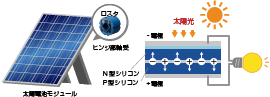 Products Used: Cushioning, Oscillation, and Anti-Vibration Devices (Rosta) |
| Wind Power | Wind turbines spin, and their rotational motion is transmitted to a generator to produce electricity. They can be installed on land or at sea. | ・Unlimited energy supply・Zero CO2 emissions・Generation fluctuates with seasons and time, resulting in unstable output・Generates noise | 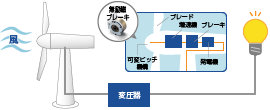 |
| Hydropower | Utilizes the elevation difference in rivers to drop water, turning a waterwheel to generate electricity. There are also small- to medium-scale types capable of generating power in agricultural irrigation and municipal water supply facilities. | ・Capable of stable, long-term operation; small- to medium-scale systems are in demand as distributed power generation (relatively high cost) | 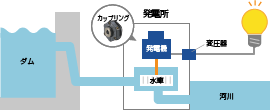 Product used: Rubber and resin couplings for prime movers (Centerflex) |
| Geothermal | Geothermal energy is extracted as steam or hot water to turn turbines and generate electricity. Abundant resources in volcanic regions. | ・Stable output; large-scale development is possible・Operates 24 hours a day・Development period of approximately 10 years; high development costs・Requires coordination with local communities (overlap with hot springs and park facilities) | 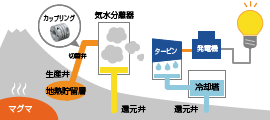 |
| Biomass | Generates electricity using biological resources such as plants and animals. Converts various resources, including woody biomass and food waste, into energy. | ・Contributes to waste reduction・Not affected by weather・Stable supply of raw materials; costs associated with collection, transportation, and management of raw materials | 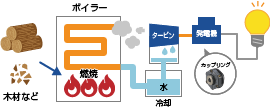 Product used: Rubber and resin couplings for prime movers (Centaflex) |
Energy Conservation Initiatives
What Are Japan's Energy Conservation Efforts?
Professor Hashimoto: When we think about energy, we also need to consider energy conservation—making sure we don’t waste energy. Japan plans to implement rigorous energy-saving measures to meet its projected energy demand for fiscal year 2030.
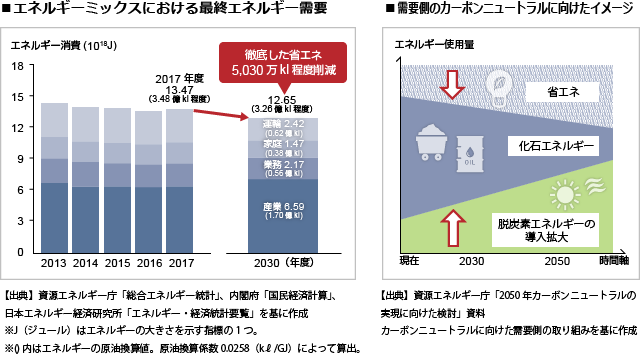
Hama-chan: Those are very strict targets. To meet them, we’ll need to implement further energy-saving measures in industry, commercial sectors, transportation, and households, won’t we?
Professor Hashimoto: Exactly! I’ll introduce some specific measures next.
A 1% Increase in Motor Efficiency Could Eliminate the Need for a 500,000 kW Power Plant!?
Professor Hashimoto: It’s said that motors—used in robots, factory equipment, refrigerators, air conditioners, and more—account for about half of the world’s electrical energy consumption. Since increasing
motor efficiency by just 1% is estimated to save 500,000 kW of energy (equivalent to the output of a single medium-sized nuclear power plant), we need to select components used in power transmission—such as couplings and clutch brakes—with a focus on improving motor efficiency.
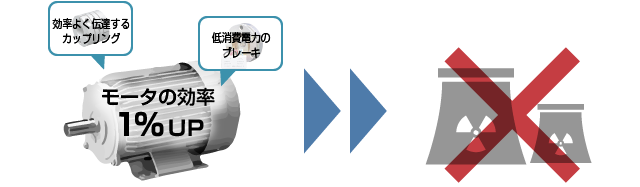
Hama-chan: I’m surprised that selecting couplings and clutch brakes can lead to energy savings!
Industry Initiatives
Professor Hashimoto: It’s said that factories in the future will have to make a concerted effort to improve energy efficiency in air conditioning systems and motors. Here are the details of those efforts.
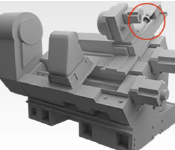
■Machine Tools
The machining accuracy of workpieces is significantly affected by changes in ambient temperature, heat generated by machinery, and heat generated during the machining process. Therefore, controlling the room temperature is critical, which requires a significant amount of electrical energy. [Energy-Saving Measures
] To achieve this in a typical factory environment, thermal displacement is controlled, and measures such
as reducing coolant consumption are implemented.
■Pumps, Compressors, and Blowers
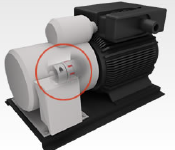
Electric motors are used in factory air conditioning systems, pumps, and compressors, and are said to account for approximately 50% of total power consumption. Efforts to improve the energy efficiency of electric motors are expected to lead to significant energy savings. [Energy Conservation Measures] Improving energy efficiency through the Top Runner Program
. Promoting energy savings and higher efficiency by replacing motors with permanent magnet (PM) motors
.
Hama-chan: So the industry is really serious about energy conservation, isn’t it?
Professor Hashimoto: At Miki Pulley, we’re also working on energy conservation, such as by installing equipment that recycles energy from our testing machines. (Endurance testing machine video ▶)
What We Can Do
Hama-chan: I see that carbon neutrality and energy issues are important topics for the industrial sector as well. Is there anything we can do in our daily lives?
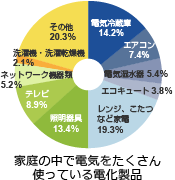
Professor Hashimoto: Of course there is. Let’s take a look at the graph on the right. The appliances that use the most electricity are refrigerators, air conditioners, and lighting fixtures. You can contribute to carbon neutrality by switching to energy-efficient models or by conserving electricity.
Hama-chan: So there are plenty of things we can start doing right away. I’d like to begin with the things we can do, like learning how to properly select couplings and clutch brakes, and reducing unnecessary electricity consumption!


Supervisor and Instructor
Mr. Hashimoto / Miki Pulley Co., Ltd.
Joined Miki Pulley Co., Ltd. in 1972. As a product manager, he oversaw marketing and technical operations, playing an active role both domestically and internationally. In addition, he has been involved in joint research projects not only with other companies but also with universities and specialized institutions. He is currently responsible for technical guidance and employee training.
