
What Are Autonomous Robots? | An Easy-to-Understand Webinar
2026/06/15
What Are AGVs and AMRs? A Comprehensive Look at Automation in Logistics Facilities and Next-Generation Autonomous Mobile Robots!
Is it true that there are self-driving robots!?
What is an AGV (Automated Guided Vehicle)?
Hama-chan: Professor Hashimoto! The other day, I spotted an AGV hard at work in the factory! I heard that they can transport a wide variety of goods in large quantities within the warehouse all on their own!
Professor Hashimoto: That’s right. They’re called AGVs (Automated Guided Vehicles). Using guidance systems like magnetic tape, these vehicles can transport necessary parts to the right places without getting in the way of workers—essentially doing the job for them. In addition to operating in factories and warehouses, they’re also used for delivery, security, and cleaning in smart buildings.
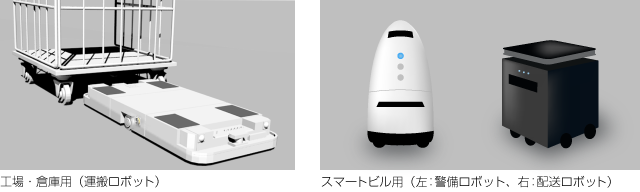
■What is an AGV (Automated Guided Vehicle)?
Abbreviation for Automation Guided Vehicle. According to JIS D 6801, it is defined as “a vehicle capable of moving automatically within a designated area to transport goods and other non-human objects, and which is not intended for use on roads as defined by the Road Traffic Act.” It travels along a predetermined route using guidance methods such as magnetic, laser, or optical systems.
■Types of AGV Navigation Methods
| Guidance method | Features | Image | |
|---|---|---|---|
| First Generation | Electromagnetic Induction | A weak alternating current is passed through metal wires embedded in the floor; the system moves by detecting the resulting magnetic field with sensors | 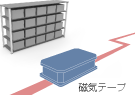 |
| Magnetic Induction | Magnetic rods or magnetic tape are installed on the floor, and the system guides the robot by reading them with magnetic sensors. While this is the most widely used system in Japan, it is expected that there will be a shift toward second- and fourth-generation systems, or that hybrid types will become more prevalent. | ||
| Second Generation | Image Recognition | The system reads symbols such as QR codes or AR markers drawn on the floor or ceiling to determine its own position. This enables high-precision positioning. | 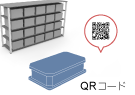 |
| Third Generation | Laser (Reflectors) | Reflectors are mounted on walls and pillars inside the building; the vehicle estimates its position based on laser reflections and navigates autonomously. A sufficient number of reflectors must be installed throughout the vehicle’s entire operating area. | 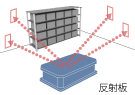 |
| 4th Generation | SLAM (Simultaneous Localization and Mapping) / Visual SLAM / LiDAR SLAM | These robots navigate by estimating their position using sensors such as cameras and lasers, along with encoders and gyroscopes. Autonomous navigation is possible without the need for guide rails. They are often referred to as Autonomous Mobile Robots (AMR), Non-Guide AGVs, or Next-Generation AGVs. | 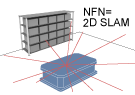 |
・While "AGV" is the globally accepted term, the autonomous type is increasingly referred to as "AMR" to distinguish it.
Professor Hashimoto: AGVs (automated guided vehicles) have been in use for some time and are capable of precise autonomous navigation. However, they were unable to determine their own routes or navigate around obstacles.
What is an AMR (Autonomous Mobile Robot)?<
Hama-chan: Aren’t there any robots that can determine their own routes and navigate on their own?
Professor Hashimoto: Robots capable of autonomous navigation are called AMRs (Autonomous Mobile Robots). They are sometimes referred to as non-guided AGVs or next-generation AGVs.
■What is an AMR (Autonomous Mobile Robot)?
Abbreviation for Autonomous (Collaborative) Mobile Robot. It does not require a guide wire and measures the distance to walls and pillars using its onboard LiDAR.It employs a method that creates a map of the surrounding environment while estimating its own position on that map. JIS D6802 "Unmanned Transport Vehicle Systems—Safety Rules" defines it as "an automated transport system that uses unmanned transport vehicles to transport and handle goods within an operational area shared with people."
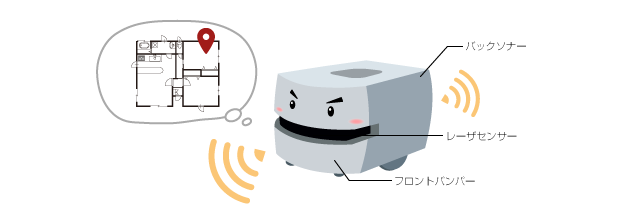
Hamachan: With the advent of autonomous mobile robots (AMRs), we can now automatically collect and transport products and parts!

What is the difference between an AMR (autonomous mobile robot) and an AGV (automated guided vehicle)?
Hama-chan: So they can transport the same products and parts! In that case, what’s the difference between AMRs (autonomous mobile robots) and AGVs (automated guided vehicles)?
Professor Hashimoto: While AGVs (Automated Guided Vehicles) function like trains running on fixed tracks, AMRs (Autonomous Mobile Robots) are more like cars that can work alongside people. If you look at the guidance systems, there are differences as shown in the diagram. I hear hybrid models are starting to appear these days, too. Also, AMRs (Autonomous Mobile Robots) are sometimes used in combination with collaborative robots!
The Difference Between AMRs
and AGVs
| AGV | AMR | ||
|---|---|---|---|
| Electromagnetic Induction | Image Recognition | SLAM | |
| Magnetic guidance | Laser guidance | ||
| Accuracy | ○ | △ | △ |
| Flexibility | ✖ | △ | ○ |
| Ease of use | ✖ | ○ | ○ |
| Reliability | ○ | △ | △ |
| Price | ○ | △ | △ |
Hama-chan: So the collaborative robots we learned about last time are being put to good use here too!
*For more details, click here ▶ What Are Collaborative Robots? Introducing Mechanisms That Ensure Safety for Robots, Machinery, and People
What are the key components of AMRs (autonomous mobile robots) and AGVs (automated guided vehicles)?
Hamachan: Could you explain the key components of AMRs (autonomous mobile robots) and AGVs (automated guided vehicles)?
Laser SLAM technology for obstacle detection
Professor Hashimoto: Fourth-generation AMRs (Autonomous Mobile Robots) generally use the SLAM method. They use cameras and laser sensors to observe their surroundings and, in combination with encoders and gyroscopes, can estimate their own position. Products that utilize SLAM technology include the latest model of cleaning robots, drone-based autonomous delivery, and Mars rovers.

■What is SLAM technology?
This refers to SLAM (Simultaneous Localization and Mapping) technology. It enables both self-localization and environmental mapping.
Hamachan: So SLAM technology is actually being used in everyday settings, isn't it!
Visual SLAM and LiDAR SLAM
Professor Hashimoto: There are two types of SLAM: Visual SLAM, which is based on image processing using camera images, and LiDAR SLAM, which is based on point cloud data measured by LiDAR.
■Visual SLAM
This technology simultaneously estimates environmental maps, 3D location data, and the camera's position and orientation from images captured by a camera; monocular and stereo cameras are commonly used for this purpose.
■LiDAR SLAM
Based on point cloud data of the surrounding environment acquired using a LiDAR (Light Detection and Ranging) laser sensor (distance sensor), the system generates a 2D environmental map in real time while simultaneously estimating its own position on the map.
Professor Hashimoto: LiDAR is used in self-driving cars, drones, and the iPad Pro released in March 2020. There are even apps now that let you scan 3D spaces and easily create augmented reality (AR) models.
Hamachan: I recently used an augmented reality (AR) app that lets you virtually place furniture in your room! The technology is really advancing!
Emergency Stop Function
Professor Hashimoto: Recent AMRs (autonomous mobile robots) and AGVs (automated guided vehicles) are being developed in sizes ranging from small to large. For large products and parts, they can even transport items weighing over one ton.
Hama-chan: That’s amazing! It seems like the functions required in emergencies will continue to increase.
Professor Hashimoto: Exactly. That’s where non-excitation brakes come into play. Brakes designed for emergency stops on AMRs and AGVs that operate day and night have to meet a wide range of requirements.
- High-capacity brakes that stop reliably
- Highly reliable brakes
- Long-lasting brakes
- Brakes with excellent maintainability
- Brakes that help save energy
- (For battery-powered AMRs (autonomous mobile robots) and AGVs (automated guided vehicles))
■AGV Drive Wheels
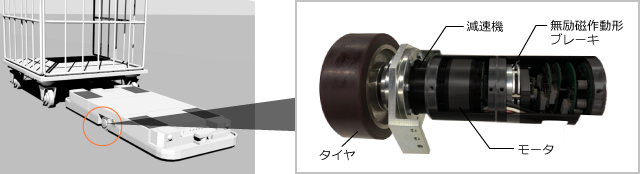
Mr. Hashimoto: The structure of the drive wheel for an AGV with an integrated motor looks like the one in the photo. The component located roughly in the center is a self-energizing brake. If the motor isn’t integrated, I recommend using a coupling to connect it to the motor. This makes removal easy and improves work efficiency during maintenance.
■Example of Coupling Installation
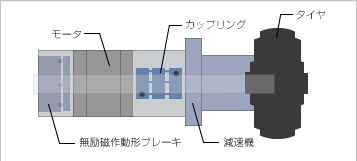
Hamachan: So, for AMRs (autonomous mobile robots) and AGVs (automated guided vehicles) to operate safely, the presence of non-energized brakes and couplings is crucial, isn't it?


Supervisor and Instructor
Mr. Hashimoto / Miki Pulley Co., Ltd.
Joined Miki Pulley Co., Ltd. in 1972. As a product manager, he oversaw marketing and technical operations, playing an active role both domestically and internationally. In addition, he has been involved in joint research projects not only with other companies but also with universities and specialized institutions. He is currently responsible for technical guidance and employee training.
