What Are Couplings (Shaft Couplings and Joints)? Their Types and Features
2026/05/07
Table of Contents
You can learn how couplings are used and why they are necessary.
You can learn about the types and features of couplings. We have included a table to help you select the right one.
What is a coupling (shaft coupling/joint)?
A coupling is a mechanical component that connects the shafts of a machine, absorbs misalignment between the two shafts, and accurately transmits power from the driving side to the driven side.
In the machinery industry, a coupling is defined as a "component that connects shafts," and is generally referred to as a "coupling," "shaft joint," or "joint."
(The English term for a shaft joint is "coupling.")
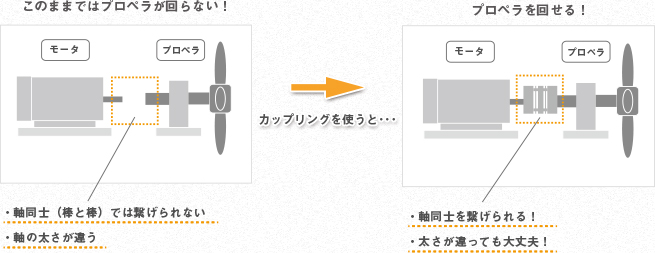
Even between shafts of different diameters, as shown in the figure below, power can be transmitted by using a coupling.
The Role of Couplings
The primary functions of a coupling are as follows:
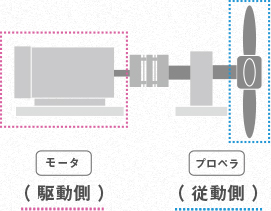
1. Transmitting power from the drive side (the rotating side) to the driven side (the side being rotated).
2. Compensating for misalignment between the drive side (rotating side) and driven side (rotated side) shafts.
3. Absorbing vibrations from the drive side (rotating side) to protect surrounding products.
4. Preventing heat from the drive side (rotating side), such as from the motor, from being transferred to the driven side (rotated side).
1. To transmit power
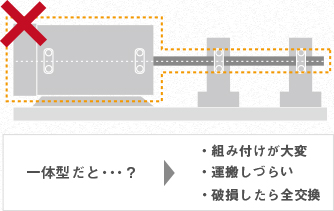
The primary reason for using a coupling is to connect the drive shaft and the driven shaft. Building a machine with
integrated shafts without using a coupling is difficult in terms of cost and precision; moreover, transporting and installing the machine becomes extremely difficult, resulting in unnecessary labor costs.
Furthermore, with an integrated design, if either the drive side or the driven side fails, the entire unit must be replaced.
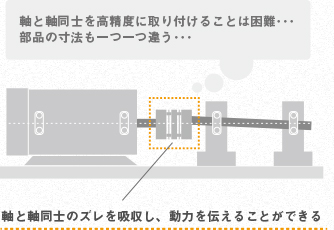
2. Compensate for installation errors (misalignment)
Attempting to align a drive shaft and a driven shaft with high precision can be extremely time-consuming. If the
shafts are misaligned, excessive force is applied to the surrounding components; since this force acts repeatedly with each rotation, it causes vibration and noise.
Furthermore, even identical parts have manufacturing tolerances and other errors, resulting in slight dimensional variations between individual components
, making it extremely difficult to assemble them with high precision every single time.
Therefore, couplings are used to compensate for such mounting errors.
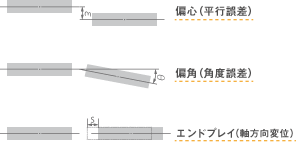
Couplings serve the purpose of transmitting power accurately and smoothly even when there is misalignment between shafts (such as eccentricity, angular misalignment, or axial displacement).
What is installation tolerance?
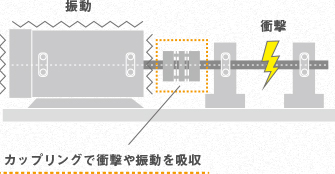
3. Absorbs vibrations to protect surrounding products
When operating machinery, vibrations or shocks may be transmitted to surrounding components. For
example, if vibrations from the drive side—such as a motor—are transmitted to a ball screw, the screw may shift from its specified position, preventing the machine from performing
at its full potential. Furthermore, if an external shock occurs, the shock would be transmitted directly to the motor without a coupling, potentially causing it to break
. A coupling is designed to solve these issues. They absorb vibrations to ensure the driven side moves with high precision, and they absorb shocks to prevent damage to expensive components such as motors.
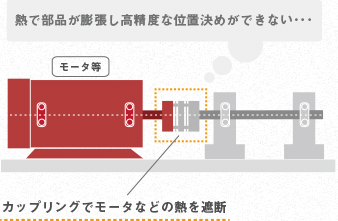
4. Do not transfer heat from the motor or other components to the driven side
Motors generate a significant amount of heat during operation. If this heat is
transferred to the driven side, components such as ball screws will expand, causing changes in their length. This prevents precise
positioning and prevents the machine from performing at its intended level of accuracy. However
, using a coupling can prevent heat from the motor or other components from transferring to the driven side, thereby preventing parts from deforming or shifting due to heat.
As such, the need for couplings varies depending on the application and operating conditions. Couplings are required to provide a
wide range of performance characteristics, including the ability to accommodate installation tolerances (flexibility), enable high-precision positioning (high rigidity), absorb vibrations to contribute to high precision and long service life, and block heat transfer.
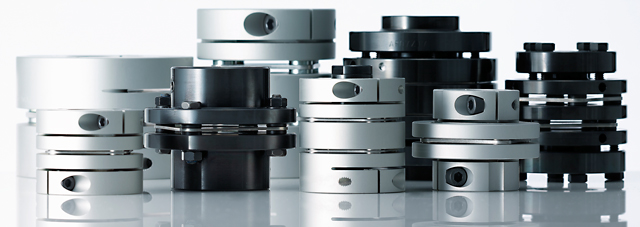
There are many types of couplings. It is important to
understand the characteristics of each type and the applications for which they are suitable, and to select the appropriate coupling for your specific use.
So, what types of couplings are there? Let’s take a look below.
Summary 1: What Is a Couple?
- It is a component used to connect the shafts of a machine.
- It is a component that accurately transmits power to the machine.
- It is a component designed to compensate for misalignment between machine shafts.
Summary 2: Performance Requirements for Couplings
- Flexibility (absorbs installation tolerances)
- High rigidity
- High precision
- Vibration damping
Types and Features of Couplings (Shaft Couplings and Joints)
The table below lists the types
and features of couplings (shaft couplings and joints), using Miki Pulley couplings as examples. We hope this will assist you in your daily selection process
.
○: Compatible △: Compatible depending on application
| Types of Shaft Couplings | Photo | Description | No Backlash | High torsional rigidity | Damping | Oil resistance | General-purpose motors | Servo motors | Stepper motors | Detector |
|---|---|---|---|---|---|---|---|---|---|---|
| Disc Type | 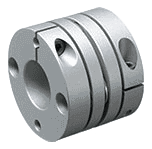 | ・Compensates for misalignment through the deflection of metal plate springs ・Low rotational transmission error, suitable for high-speed rotation | ○ | ○ | ○ | ○ | ○ | ○ | ||
| Rigid Type | 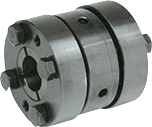 | ・Simple cylindrical structure ・Ultra-high rigidity , low inertia | ○ | ○ | ○ | ○ | ||||
| Metal Slit Type | 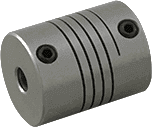 | ・Integrated structure with spiral slits in a cylindrical body・Compact, low inertia, high flexibility | ○ | △ | ○ | ○ | ○ | ○ | ||
| Metal Coil Spring Type | 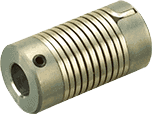 | ・Absorbs axial misalignment through the deflection of the coil spring・Highly flexible | △ | ○ | ○ | △ | △ | |||
| Pin-and-bushing type | 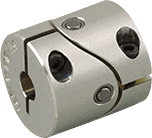 | ・Absorbs axial misalignment through pin-bush sliding ・Accommodates large eccentricity and angular misalignment while minimizing axial reaction force | △ | ○ | △ | △ | ||||
| Link Type | 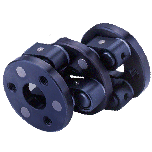 | ・Allows for parallel movement of the shaft center during rotation・Accommodates large displacements and eccentricity | ○ | |||||||
| Magnetic Type | 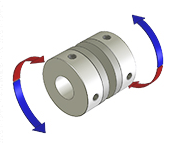 | ・Transmits power non-contact via magnets; zero friction and dust generation . Ideal for cleanrooms, pumps, and food processing equipment | ○ | ○ | ○ | |||||
| Jaw Type | 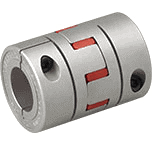 | ・Structure consisting of two hubs with rubber or resin sandwiched between them ・Absorbs vibration and is easy to install | △ | ○ | △ | ○ | ○ | ○ | ||
| Resin Bellows Type | 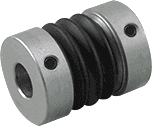 | ・Structure consisting of two hubs and a resin bellows. Compact and highly flexible | ○ | △ | ○ | △ | ||||
| Rubber/Resin Type for Power Units | 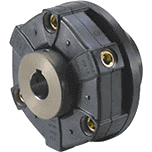 | ・Rubber compression structure and resin element structure ; provides vibration absorption and is suitable for engine applications | ○ | △ | ○ and engines |
Miki Pulley Coupling Variations
Miki Pulley offers a wide range of couplings designed to accommodate various drive sources, from general-purpose motors to servo motors requiring
ultra-precise control, and even engines that generate significant vibration and shock.
For example, we offer metal disc-type couplings for servo motors and high-damping laminated rubber couplings that achieve high damping performance and low reaction forces. We also
provide metal slit-type couplings with an integrated spiral slit structure and highly versatile jaw couplings. Additionally
, we offer rubber and resin couplings for prime movers that absorb vibration and shock using elastic rubber.
At Miki Pulley, we will propose the optimal coupling for your specific application from this diverse range of products, each with its own unique features.
Features of Miki Pulley Couplings
Miki Pulley, a leader in the industry with the top market share, offers a wide variety of couplings with tens of thousands of different configurations. With
our flexible customization options and capacity for mass production,
we can provide you with the coupling that best suits your equipment. In addition, our team of highly skilled engineers is on hand to help you select the perfect coupling for your specific needs. Please feel free to contact us.
Miki Pulley Couplings
At Miki Pulley, leveraging the advanced technology unique to a specialist manufacturer of power transmission equipment, we offer an extensive lineup of optimal couplings—including custom solutions—to address a wide range of issues such as shaft deflection caused by machinery operation, thermal expansion of shafts, vibration and resonance phenomena, and bearing wear.
Our skilled technicians will select the right coupling for your equipment!
Are you experiencing any issues with your equipment?
At Miki Pulley, we can select and customize the perfect coupling for your equipment from our wide range of options!
>Feel free to contact us using this form!