
What Are Collaborative Robots? | An Easy-to-Understand Webinar
2026/05/07
What Are Collaborative Robots? An Introduction to Mechanisms That Ensure the Safety of Robots, Machinery, and People
Is it really true that humans, machines, and robots work together!?
What are collaborative robots?
Collaborative robots are robots that operate in the same space as humans. In
recent years, robots have been developed that can grasp and transport objects while avoiding human hands.
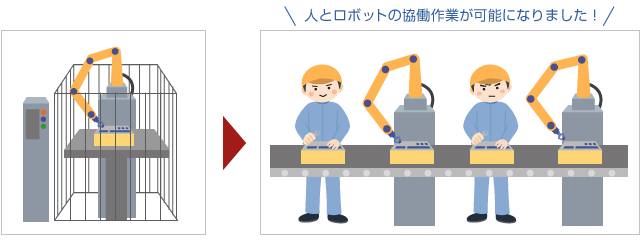
Professor Hashimoto: As I mentioned last time, industrial robots are often operated in areas where people cannot enter, such as inside safety fences. However, collaborative robots are designed with sensors that activate in the event of contact or collision with people or obstacles, and they stop depending on the force of the impact. Because the risk of harming people is reduced in accordance with safety standards, they can operate even in environments where people are present.
Hama-chan: With the declining birthrate and labor shortages being such a concern, it seems like productivity would go up if we could work alongside industrial robots!
What about safety measures for robots, machinery, and people in emergencies?
Hama-chan: It’s great that we can work alongside robots, but wouldn’t it be dangerous if an emergency like a power outage were to occur?
Professor Hashimoto: That’s true. Safety measures for emergencies are specified in JIS (B 8433-1:2015).
・Must have at least one emergency stop function ・Must be equipped with an emergency stop function that can be activated
manually [Reference] JIS
Standard https://kikakurui.com/b8/B8433-1-2015-01.html
As you can see, the standard requires the construction of a structure that does not harm people and a safety system capable of detecting impacts. This is where the emergency brake (▶ de-energized type brake) introduced in the robot components section comes into play.
Non-excitation-type brakes that protect the safety of robots, machinery, and people
What is a non-energized brake?
A non-energized brake is an emergency brake that activates when no power is applied. *For
more details, click here ▶ What is an electromagnetic clutch/brake?
In what situations are non-energized brakes used?
Hama-chan: In the context of industrial robots, in what situations are non-energized brakes used?
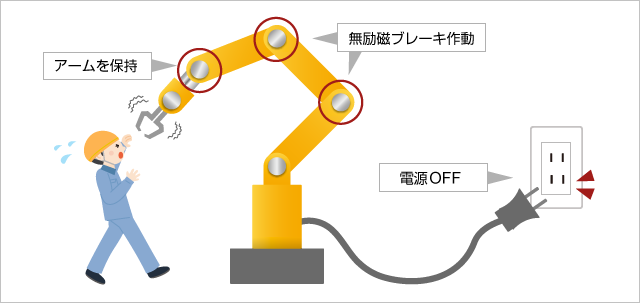
Professor Hashimoto: Non-excitation-type brakes come into play when a robot performs an emergency stop. During an emergency stop, the non-excitation-type brake activates to immobilize the robot’s joints. This prevents the arm from hitting people or machinery.
Hama-chan: I’m relieved to know that safety measures are properly in place. So, non-excitation-type brakes are essential for robots, aren’t they? Come to think of it, a senior in the Engineering Department was working on a way to increase torque while making non-excitation-type brakes smaller and lighter. I see that this technology is being put to use in robot systems! I need to study harder so I can catch up with my seniors!


Supervisor and Instructor
Mr. Hashimoto / Miki Pulley Co., Ltd.
Joined Miki Pulley Co., Ltd. in 1972. As a product manager, he oversaw marketing and technical operations, playing an active role both domestically and internationally. In addition, he has been involved in joint research projects not only with other companies but also with universities and specialized institutions. He is currently responsible for technical guidance and employee training.