
Formulas for Moment of Inertia (J) Calculation
2026/06/15
Table of Contents
Basic Formula
The basic formula for the moment of inertia is "the product of the mass M [kg] of the rotating body and the square of its radius R [m]," where the rotation occurs about the center of the rotating body. Furthermore, even in cases where the center of rotation is offset, the object is not cylindrical, or it is moving in a straight line, the moment of inertia can be calculated as long as it is known what is rotating and at what position.
Moment of inertia = mass × radius squared (J = M·R²)
Formula for the moment of inertia
Formula for the moment of inertia of a hollow cylinder
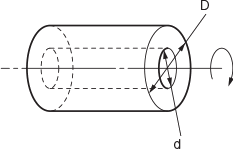
D: Outer diameter of the cylinder [m]
d: Inner diameter of the cylinder [m]
M: Mass of the cylinder [kg]

[Calculation Example]
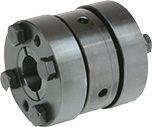
Product: Servo-Rigid Coupling "SRG-050DS"
Mass M: 0.45 [kg] (at maximum bore diameter)
Outer diameter D: 48×10⁻³ [m]
Bore diameter d: 22×10⁻³ [m] (maximum bore diameter)
*Although the product has tapered surfaces, it is treated as a simple hollow cylinder for calculation purposes.
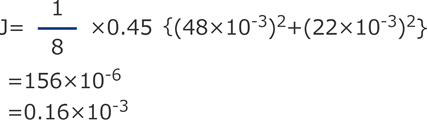
*This value matches the moment of inertia listed in the catalog.
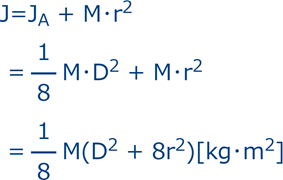
Formula for calculating the moment of inertia of a cylinder when the center of rotation is offset
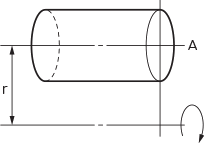
r: Radius of gyration [m]
D: Diameter of the cylinder [m]
M: Mass of the cylinder [kg]
JA: Moment of inertia about the center of the cylinder [kg·m²]
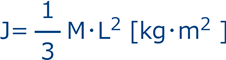
Formula for calculating the moment of inertia of a rotating rod
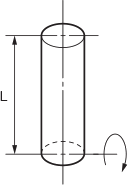
L: Length of the rod [m]
M: Mass of the rod [kg]
Formula for calculating the moment of inertia of a rod when the center of rotation is offset
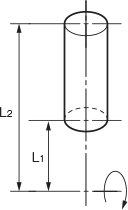
L1, L2: Distance from the center of rotation [m]
M: Mass of the rod [kg]

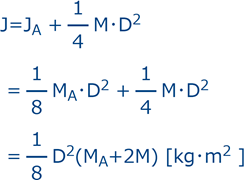
Formula for Calculating the Moment of Inertia of a Winding Mechanism
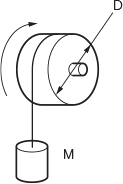
JA: Moment of inertia of the drum [kg·m²]
D: Diameter of the drum [m]
M: Mass of the load [kg]
MA: Mass of the drum [kg]
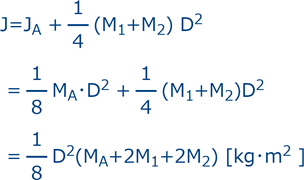
Formula for calculating the moment of inertia when a counterweight is present
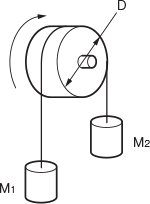
JA: Moment of inertia of the drum [kg·m²]
D: Diameter of the drum [m]
M1, M2: Mass of the load [kg]
MA: Mass of the drum [kg]
Formula for the moment of inertia of a rectangular prism
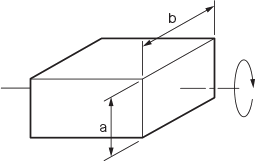
a, b: Edge lengths [m] M: Mass of the rectangular prism [kg]

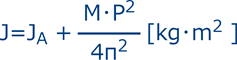
Formula for calculating the moment of inertia of an object undergoing linear motion driven by a lead screw
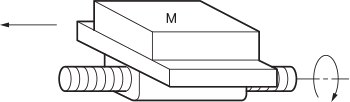
JA: Moment of inertia of the lead screw [kg·m²]
P: Lead of the lead screw [m]
M: Mass of the load [kg]
Formula for calculating the moment of inertia when using a rack-and-pinion drive
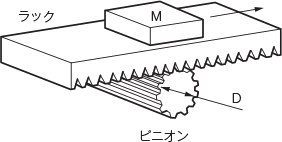
JA: Moment of inertia of the pinion [kg·m²]
D: Diameter of the pinion [m]
M: Mass of the rack and load [kg]
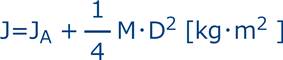
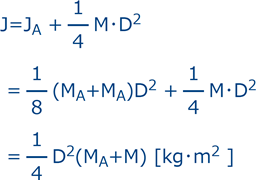
Formula for Calculating the Moment of Inertia of a Conveyor Belt
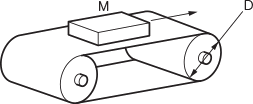
JA: Moment of inertia of the roller [kg·m²]
D: Diameter of the roller [m] (assuming both sides have the same diameter)
M: Mass of the load [kg]
MA: Mass of the roller [kg]
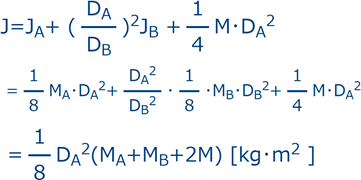
Formula for calculating the moment of inertia when the workpiece is clamped between rollers
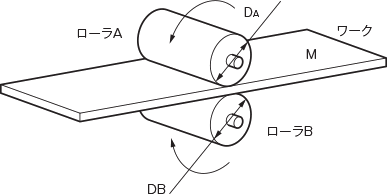
JA: Moment of inertia of roller A [kg·m²]
JB: Moment of inertia of roller B [kg·m²]
DA: Diameter of Roller A [m]
DB: Diameter of Roller B [m]
M: Equivalent mass of the workpiece [kg]
MA: Mass of Roller A [kg]
MB: Mass of Roller B [kg]
Formula for Calculating the Equivalent Moment of Inertia of a Motor Shaft
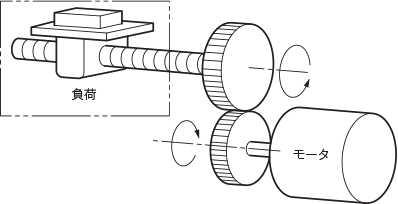
Z1: Number of teeth on the
motor-side gear\
Z2: Number of teeth on the
load-side gear\
R: Reduction ratio Z2/Z1
JA: Load moment of inertia [kg·m²]
J1: Motor-side gear moment of inertia [kg·m²]
J2: Load-side gear moment of inertia [kg·m²]

What is moment of inertia?
The moment of inertia is a measure of how easily or difficult it is to rotate an object. *Since the English term is "moment of inertia," it is sometimes referred to simply as "inertia." *In mathematical formulas, it was traditionally denoted by "I," but to avoid confusion with electric current, it is now denoted by "J." For example, consider rolling a ping-pong ball and an iron ball of the same size to a certain speed. The ping-pong ball starts rolling with a light force, but moving the iron ball requires more force than the ping-pong ball. Conversely, when a ping-pong ball and an iron ball are rolling at the same speed, the iron ball requires far more time and distance to come to a natural stop. If you try to stop them forcefully, the iron ball requires more force. Thus, the ease with which an object can be accelerated to a certain speed, and the amount of force remaining when attempting to stop an object from that speed, is referred to as inertia.

In other words, since a high moment of inertia makes it difficult to rotate or stop the machine, it can be said that machines that repeatedly switch between forward and reverse rotation (including the Miki Pulley products you use) are easier to control when they have a lower moment of inertia. Furthermore, easier control helps reduce vibration and improve the machine’s precision, resulting in high-precision products.
The Need for Moment of Inertia
Why is it necessary to calculate the moment of inertia? As mentioned earlier in "What is the Moment of Inertia?", high-precision products can be achieved because of the relationship between the moment of inertia and torque shown below. Rotational torque T [N·m] = Moment of inertia J [kg·m²] × Angular acceleration α [rad/sec²] Angular acceleration is the change in angular velocity per unit time as an object rotates; it is the derivative of angular velocity with respect to time. The unit is radians per second per second. To calculate the torque required to rotate a stationary object at a certain acceleration (or angular acceleration), or the torque required to stop a rotating object, the value of the moment of inertia is necessary. Therefore, it is important not only to calculate the moment of inertia but also to use various equations based on that value to achieve an optimal mechanical system.
The International System of Units and the System of Weights and Measures
Currently, the moment of inertia is expressed in the International System of Units as J = M·R² [kg·m²]. In the traditional weight-based unit system, it was expressed as I = W·R²/g [kgf·m·s²]. (W: weight, g: gravitational acceleration) Furthermore, in the traditional weight-based unit system, GD² = W·D² [kgf·m²] was also used.(D: diameter of the rotating body) This GD² is also known as the “flywheel effect” and was used particularly in calculations for motors and similar devices. A flywheel is also known as a flywheel. For example, if the rotational speed drops suddenly due to a power outage, shock may be transmitted to the machinery, potentially causing damage. This concept is similar to the load experienced by passengers inside a train that comes to a sudden stop. Therefore, to reduce the rotational speed gradually, a rotating body with a large moment of inertia is installed. This is the flywheel. In addition, the rotational output of an engine is subject to irregularities caused by piston movement. The flywheel reduces these irregularities and stabilizes the rotation.
Other Technical Documents
↓You can download a PDF compilation of the technical documents below.
Specifications
Hole Machining, Tolerances, and Fits
Calculations, Conversions, Formulas, and Units
Machine Elements
- Hexagon Socket Head Cap Screws (Cap Bolts) Standards List | Excerpt from JIS B 1176
- Shapes and Dimensions of Hex Socket Set Screws (Excerpt from JIS B 1177-1997)
- Shapes and Dimensions of Hex Bolts (Component Grade A) (Excerpt from JIS B 1180-1985)
- How to Use Hex Socket Set Screws
- Mechanical Properties of Steel Bolts and Screws (Excerpt from JIS B 1051-2000)
- Shapes and Dimensions of Hexagonal Wrenches (Hex Wrenches/L-Wrenches/Hex Wrenches) (Excerpt from JIS B 4648:2008)
- Dimensions and Tolerances of Parallel Keys and Keyways: List of Standards (Excerpt from JIS B 1301-1996/JIS B 1301-1959 [Old JIS])
- Snap Rings (C-Clips/C-Rings) Standards and Dimensions List (Excerpt from JIS B 2804-2010)
- Shim Dimensions
- Ball Bearing Standard Dimensions Table - JIS Excerpt
Material Properties
Terminology
- Glossary of Electromagnetic Clutch and Electromagnetic Brake Terms (Excerpt from JIS B 1404-1:2005)
- Glossary of Screw Terms (JIS B 0101:2013)
- Glossary of Fit Tolerances (Excerpt from JIS B 0401-1:2016)
- Glossary of Terms for Chains, Sprockets, and Accessories (Excerpt from JIS B 1812:2015)
- Glossary of Friction Belt Drive Terms (Excerpt from JIS B 1860:2018)
- Technical Drawing—Terminology (Excerpt from JIS Z 8114:1999)